Blog

Cats with a Bossy Personality

Adapted from an article originally published on natusan.co.uk

Cats can be quite particular creatures, and pet parents know that their unique personalities can be very different.

Even in the same household, and from the same litter, our furry friends can vary quite a lot when it comes to their individual habits and quirks.

Researchers have found five cat personality types, and find most cats fall into one of the following categories – Neurotic, Extraverted, Dominant, Impulsive or Agreeable.

In this blog: the dominant, or bossy, cat.

Cats who fall into this category tend to be the most dominant, and are especially easy to spot in multi-cat households – they are the ones at the top of the pecking order (including you).

These cats know just how to manipulate their owners, and can wrap you around their little toe-beans. 

Top tips for bossy cats

First impressions matter – when introducing new members of your pet family, use the “two-door method” to gradually let them get to know each other, slowly removing the barriers until they can get acquainted.

Share the love – For households with more than one cat, be sure to show equal attention and affection for each member of your clique, you may have a favourite, but they don’t need to know that.

Food, the great motivator – You’d be surprised how quickly your cat can straighten up and fly right when dinnertime comes into question, if you have more than one cat, provide separate feeding areas and bowls to avoid the dominant cat taking the lion’s share.

Tough love – As much as we’d like to let them think our lives revolve around them, sometimes a cat needs to know that it isn’t the boss. Whether it’s by feeding yourself first before them, or simply not jumping to attention whenever they call, just don’t expect a pleasant reaction when you try to take back your favourite spot on the sofa…

Consider a permanent “fix” – Neutering or spaying your cat can help to control the hormones responsible for some undesirable behaviours. If needed, a specialist veterinary behaviourist can help you live in harmony with your cat.

Live with it – Cats, while fairly resilient and adaptable, can be set in their ways. If they’ve been “top cat” for too long, you may just have to deal with the fact that you’re seen more as a servant than a parent, in which case you should just be grateful to have such a merciful ruler.

It is worth noting that most “undesirable” behaviours are just cats expressing their natural behaviours, but perhaps in a place or at a time which isn’t appealing to us as humans!

Cats with an Outgoing Personality

Adapted from an article originally published on natusan.co.uk

Cats can be quite particular creatures, and pet parents know that their unique personalities can be very different.

Even in the same household, and from the same litter, our furry friends can vary quite a lot when it comes to their individual habits and quirks.

Researchers have found five cat personality types, and find most cats fall into one of the following categories – Neurotic, Extraverted, Dominant, Impulsive or Agreeable.

In this blog: the extraverted, or outgoing, cat.

Cat walking outside

Cats in this category are much more extraverted and often more noisy than most cats.

They’re also the kind who like to get into the most trouble, mostly due to how easily they get bored and resort to destructive behaviours to get attention (we’ve all been there).

Top tips for outgoing cats

Work hard on playing hard – Provide plenty of toys for your cat to play with, and be sure to replace them with fresh toys as they can soon stop smelling quite so interesting to cats.

“Baby”-proof your home – If your cat has a naughty habit of opening cupboards and doors, invest in child-proof door stoppers to keep what’s inside from falling into the wrong paws.

Reward good behaviour – When you notice your cat playing nicely, for example not biting your guests’ ankles, be sure to let them know how pleased you are with a treat or some fuss and attention.

Keep distractions close to hand – A tactically-placed scratching post or well-timed play session can greatly improve the longevity of your sofa or other furniture.

Use “time-outs” – If your cat gets a bit too overzealous with the rough-housing, consider placing them in “kitty jail”. A few minutes in a designated empty room can help to calm down their zoomies (just make sure it isn’t where you keep your priceless art…)

Be patient – Cats can be quite wild at times, but remember that they lack the capacity to do things out of spite or meanness, though it can seem this way sometimes.

It is worth noting that most “undesirable” behaviours are just cats expressing their natural behaviours, but perhaps in a place or at a time which isn’t appealing to us as humans!

Cats with a Nervous Personality

Adapted from an article originally published on natusan.co.uk

Cats can be quite particular creatures, and pet parents know that their unique personalities can be very different.

Even in the same household, and from the same litter, our furry friends can vary quite a lot when it comes to their individual habits and quirks.

Researchers have found five cat personality types, and find most cats fall into one of the following categories – Neurotic, Extraverted, Dominant, Impulsive or Agreeable.

In this blog: the neurotic, or nervous, cat.

Cats who score in this category tend to be more highly-strung than others, and can also be the most shy.

These cats love a hiding spot, so give them plenty of spaces around your home for them to retreat to.

Over time, and with the right support, these cats can become just as confident and cuddly as any feline, albeit only to those they truly love (which makes it even better!)

Top Tips for Nervous Cats

Give them space – Boxes, cat tunnels and other “safe spaces” are very important to nervous cats. 

Reduce “triggers” – If possible, try to determine and avoid things that may cause anxiety for your cat. For example, if your cat is scared of the hoover, take them to another room before flipping the switch.

Be patient – It may take a while until your cat is comfortable enough for a cuddle, and some cats just plain don’t like it. Respect your cat’s personal space and try to read their body language.

Try distractions – If your cat is triggered by something beyond your control, such as fireworks, try shutting the curtains and playing soothing music or television (ours love a bit of Attenborough)

Keep calm and purr on – Your cat is an expert at picking up your vibes, so try to stay cool, calm, and collected, and hopefully your cat will do the same.

Make a routine – cats are creatures of habit, and aren’t too fond of change, so bear this in mind, try to sync your schedules and don’t interrupt nap time (this goes for humans, too)

It is worth noting that most “undesirable” behaviours are just cats expressing their natural behaviours, but perhaps in a place or at a time which isn’t appealing to us as humans!

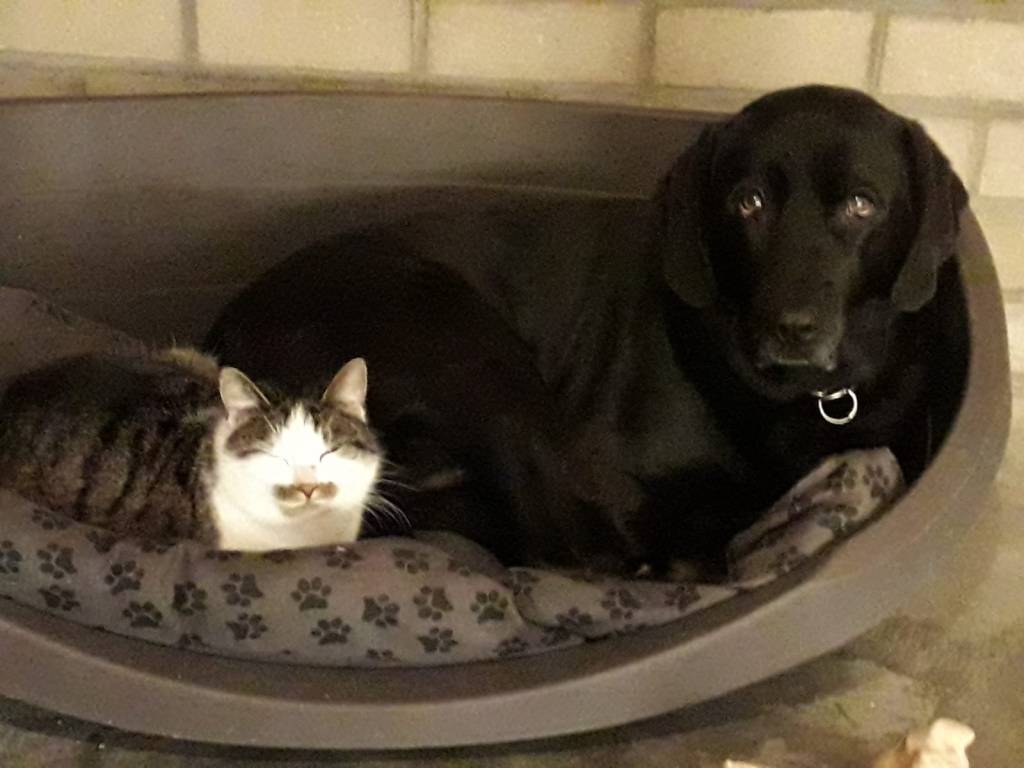
Freddie Pip and Kaya: Like Cat and Dog?

My parents have always had both dogs and cats. Usually, the cats and dogs did not get along. Their current dog Kaya did not get along with the previous cat at all. So when they got Freddie Pip we all suspected they would not get along either.

They do however!

This is probably mainly because Freddie Pip is not scared of Kaya at all and does not run away from her. Dogs tend to enjoy chasing cats that run away from them and cats tend to hiss or swipe at dogs.

These two quite like each other though. They’ll sniff each other when one of them comes inside. When Freddie Pip is in the dog bed, the Kaya sits outside her bed and looks sheepish. But when Kaya is in the dog bed first, Freddie Pip just joins her 🙂

From the Life of a Cat Sitter

In this series of posts I share some anecdotes from my life as a cat sitter. I promise these stories are all true, though the cats’ names have sometimes been changed to protect their identity 😉

Today: the cat that was stuck behind the kitchen cupboards!

It was my very first time looking after these two cats and during the meeting Phil was happy to see me, but Bagheera was very shy and wanted to hide. That is OK. I am patient and it takes as long as it takes for a cat to trust me and feel OK around me.

His owner showed me where Bagheera likes to hide (under the bed, in the wardrobe, but also behind the washing machine).

First visit: Bagheera was nowhere to be found! Impossible, because these are indoor only cats. Still, I did not see him anywhere despite looking everywhere, even inside the washing machine.

Then I heard something. It sounded like scratching. I realised where he was: behind the kitchen.

You might wonder how I knew this: he was not the first cat that had got stuck behind the kitchen. I knew of two others who had got stuck behind the tall cupboards of the kitchen (not on my watch I might add).

As much as I wanted to give Bagheera time to get used to me, I had to make sure he was OK and not injured. I had no idea whether he’d climbed down on purpose or fallen down accidentally. Time to put my DIY skills to use and remove the skirting board (a remarkably easy click-on system). I saw him stuck next to the fridge trying to climb back up but unable to get any grip. I got hold of him and gently pulled him out and checked him over. He was OK, no visible injuries and not showing any signs of pain when I checked him over.

I let go of him and soon the mystery of whether he’d climbed down or fallen was solved: he ran away, jumped onto the kitchen worktop, jumped onto the tall cupboard and went right back down again!

I left the skirting board off so at least Bagheera could come out after I’d left and would not be stuck in his predicament. However, I also blocked off the top of the tall cupboards to make sure they were cat proof.

Lesson learned: I now always ask whether the kitchen is cat proof or whether there are any gaps behind tall cupboards where the cat might get stuck.

Bagheera and I have since become friends 🙂