Blog

Brushing your cat’s teeth

February is Pet Dental Awareness Month, an issue close to my heart as my own cat suffers from tooth resorption. All my blog posts this month will be dedicated to dental health in cats to highlight the importance of this issue. Today, I am re-posting this blog about brushing your cat’s teeth

Dental hygiene is as important for cats as people.
It helps keep your cat in great condition and prevents diseases (and a bad breath).

Still, you may feel a little unsure about brushing your cat’s teeth. I know I was a little taken aback when my vet first suggested brushing Dirk’s teeth.
He showed me ho
w to do it and – surprisingly – Dirk seemed fine with it.
However, trying it at home was a different story…   
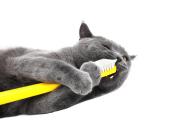
cat brushing teeth
If only it was this easy!


When I first started I was a bit too optimistic. Having seen the vet do it made me think it wouldn’t be so difficult. Dirk was not happy about it though. I tried every other day at first but I have to admit this soon became less frequent. Until Dirk was diagnosed with a dental disease called feline resorptive lesions.

After he had two teeth removed my mind set changed. I went from ‘I’ll try’ to ‘OK, I have to do this’.

Around this time I also started with my advanced feline behaviour course and was learning about learning theory and training cats. This was the perfect opportunity to put what I’d learnt into practice!

I took small steps to get Dirk used to having his teeth brushed. Admittedly, he still doesn’t like it. He tolerates it now although we have to odd day where he doesn’t. Those days are less frequent now, I brush his teeth most days. And afterwards he gets a special reward: his favourite treat which he goes nuts for.

The basics:

20190417_175628

  • First of all, buy toothpaste for cats. Toothpaste for people is toxic for cats, so never use this. Toothpaste for cats comes in tasty flavours such as chicken. Rest assured, even though it is tasty it also contains all the enzymes needed to clean your cat’s teeth.
  • Introduce your cat to the toothpaste. Let your cat lick the toothpaste off your finger (my cat loved it!). This allows the cat to get used to the flavour and texture and they will have a positive association with the toothpaste.
  • Once your cat is used to the toothpaste you can introduce a toothbrush, for example by letting your cat lick the toothpaste off the brush. There are several types of brushes designed for cats. Buy the one you feel most confident using.

Getting the job done:20190417_180510

  • Both you and your cat should be calm and comfortable before you start brushing your cat’s teeth.
  • Either sit behind your cat so they cannot escape or ask someone else to hold and soothe your cat.
  • Start by stroking and reassuring your cat. If you notice your cat becoming stressed, then don’t start brushing. Try again another day. If you turn this into a routine then your cat will become more relaxed over time and will allow you to brush their teeth.
  • Gently pull back your cat’s lips as shown in the picture.

What it looks like at the vet’s…        What it looks like at home
(Dirk prefers to lie down on his side)

  • Brush the teeth in slow circular motions and keep the bristles at a 45-degree angle. Brush the teeth and just beneath the gum margin, don’t brush the gums directly.
  • Brush as many teeth as the cat allows and praise your cat while doing so. Initially you may only be able to brush for about 10-15 seconds, but that’s a good start! When you’re more experienced and the cat has become more tolerant of having their teeth brushed you’ll be able to brush their teeth in about 1-2 minutes.

For more information please ask you vet or veterinary nurse.
For a video instruction, as well as additional information, please consult International Cat Care’s website.

“Suffering Dental Pain in Silence”: A Case Study

February is Pet Dental Awareness Month, an issue close to my heart as my own cat suffers from tooth resorption. All my blog posts this month will be dedicated to dental health in cats to highlight the importance of this issue.

* Adapted from katzenworld.co.uk

Skye, an 8-year old cat with a heart murmur, who came into the Bermondsey based clinic for an oral examination, is a typical case of advanced dental issues. Her gums were very inflamed and some of the teeth were broken due to ‘tooth resorption’ where the body’s own cells destroy tooth structure.

Dr. Campbell says: “Tooth resorption is a common dental disease in cats over 4 years of age and this case highlighted how much cat’s hide their pain particularly dental pain. Skye had a very healthy appetite and had no problems with eating or ‘hunting’. Her owner is a wonderfully observant and attentive carer but it is impossible to see this far back in the mouth of even the most malleable cat without a proper oral examination by your vet or nurse.”

Dr. Campbell recommended that Skye come in for a Comprehensive Oral Health Assessment and Treatment (COHAT)*. First, he performed a non-invasive cardiac ultrasound (echocardiography) and chest radiographs (x-rays) to investigate the cause of Skye’s heart murmur and to assess risks prior to a general anaesthetic. She was found to have structural changes in the left side of her heart but was considered to be low risk for an anaesthetic adverse event. Skye’s anaesthetic protocol was tailored to her conditions and designed to keep her heart rate nice and relaxed and lungs well oxygenated. She was placed into an oxygen tent for 30 minutes before her anaesthetic to allow her to take in the very rich oxygenated air.

The clinic’s nurses use a multi-parameter monitor for constant monitoring of the heart rate, body temperature, blood pressure and breathing (capnography) allowing any alterations to be made minute-by-minute. Dental nerve blocks were used, which reduce intra and post-operative pain and the amount of overall general anaesthetic required which is even better for the heart. Full mouth x-rays were taken which are essential to determine disease below the gumline and a dental chart was completed recording all details for every tooth. Skye had four teeth removed in total, and is now making a good recovery.

* Full details about COHAT available here: http://www.thelondoncatclinic.co.uk/cohats-comprehensive-oral-health-assessment-and-treatments/

Vet Warns That Cat Population is “Suffering Dental Pain in Silence”

February is Pet Dental Awareness Month, an issue close to my heart as my own cat suffers from tooth resorption. All my blog posts this month will be dedicated to dental health in cats to highlight the importance of this issue.

* Originally published by katzenworld.co.uk

Around 85% of cats aged over three suffer from some degree of dental disease, and regular brushing of the pet’s teeth can help, says a leading London-based feline vet.

Dr. Jeremy Campbell, Clinical Director at The London Cat Clinic, one of only a handful of practices in the UK that is cat-only, recommends tooth brushing together with 6-monthly to yearly dental checks to spot disease early. This can help prevent the formation of tartar, which can slow the progression of diseases such as gingivitis and periodontitis.

Dr. Campbell explains: “One thing that pet owners can do at home to help reduce the progression of dental disease in their cat is brushing the teeth regularly where possible. This isn’t easy with cats and they need to be trained from kitten-hood but it is possible.

“Owners are often under the impression that feeding 100% dry food will ‘clean’ their teeth sufficiently. However, recent studies have shown that regular dry food has little abrasive qualities, as cats tend to chew too quickly for any real impact. Any effect it has is at the tip of the tooth and most diseases in cats are at the gum level or below the gum line much higher up.”

The London Cat Clinic offers a Comprehensive Oral Health Assessment and Treatment (COHAT), including dental radiography.*

A further problem contributing to “the silent suffering”, explains Dr. Campbell, is that cats also tend to ‘hide’ dental disease from their owners, so dental disease may go undiagnosed until the animal is more likely to be in severe pain.

Symptoms include lethargy, decreased appetite, bad breath and inactivity. Left untreated, dental disease can affect the organs, causing damage to the kidney and liver.

Many pet owners are also concerned about the risks of subjecting their pet to a general anaesthetic – particularly if they have an existing medical condition.

Dr. Campbell says: “Pet owners whose cats have underlying diseases or are elderly are often reluctant to bring in their cats in for a dental examination, as they are concerned that their cat will not be a good candidate for general anaesthetic. Often, however, this is not the case. We carry out checks appropriate to their age and any existing problems to allow us to assess risks and to plan accordingly.”

He added: “Cats should ideally have their teeth examined by a vet or nurse at least once every 12 months. Cats that have had dental problems should be examined once every 3-6 months depending on their condition.

“Generally, the sooner the problem is identified, the easier and quicker it is to treat. Even if the cat’s mouth is being examined every day, dental disease will develop and gradually progress. Cats will quite often not show clinical signs until the disease is advanced, by which time many teeth may need to be extracted.”

From the Life of a Cat Sitter

As you may have read before, I also work as a cat sitter.

In this series of posts I share some anecdotes from my life as a cat sitter. I promise these stories are all true, though the cat’s names have sometimes been changed to protect their identity 😉

Today: a case of mistaken identity

I sometimes cover for colleagues when they are away and it’s not aleays possible to meet clients and their cats beforehand. However, we brief each other about the cats and their needs. On one occasion though, we had not briefed each other about what the cat looks like…

I went in to visit Stevie. Some rooms are off limits for him but he can come inside or go out as and when he pleases. So I wasn’t too surprised not to see him inside and opened the door to go into the garden. Sure enough, “Stevie” soon approached me and wanted lots of fuss and cuddles and breakfast of course.

As I walked into the house again I heard meows coming from somewhere, but not from “Stevie”. I listened carefully and they seemed to come from behind one particular door to a room that was off limits when the client was away. Guess where Stevie had spent the night? He ran into the garden as soon as I let him out of the room only to go and lie down next to “Stevie”. Turned out Stevie and his imposter were besties!

How To Work From Home With A Demanding Cat

* Originally written by William O’Brien for ProtectaPet

In recent times, the act of working remotely from home has become a massive trend, especially during and after the lockdowns due to the Covid-19 pandemic. A lot of us find it much easier and less restricting than having to go into the office five days a week, and we get to work from the comforts of our own home. 

However, where there are pros to working from home, there are all sorts of unique challenges that arise in these new working environments, especially for owners of demanding pets. For us cat owners, working from home can mean more quality time spent with our feline friends but it can also present challenges that you need to overcome in order to establish a healthy balance of work time and play time.

If your cat is particularly demanding, giving them access to the outdoors whilst being protected from the usual risks can help your cat to exert that additional energy. ProtectaPet offers a range of Cat Fencing solutions to keep your cat safe outdoors, available for DIY or installation.

Set Boundaries

Most of us will know that cats do as they please and when they want. They stroll up and down their palace corridors deciding where they want to sleep, eat and relax. A lot of us have transitioned into working from home either on a flexible or permanent basis, so setting some boundaries between you and your cats might be the best option for you.

If you’re cat is particularly needy and you are struggling to help them be more independent, check out this article by Noots. 

If you’re trying to have an important meeting, or if you are working towards a big deadline then you might need to think about not allowing your cat into the office or training your cat to not climb up onto your laptop and sit on your keyboard. Cats have a reputation for doing what they want, especially for love and attention, so training your cat might be the best option for you, as just shutting the door on them might cause some distress. Training them will take time, but it will be worth it when your cat stops knocking over a hot coffee onto some important documents! 

Set a Routine for You and Your Cat

Just because working from home can be a comforting way to work, we still need downtime and who better to do this with than with our cute cat companions. Also, setting aside time for you and your cats will ensure that you are giving them enough love and attention so that you can go back to work undisturbed, leaving your cat satisfied. Ensure that you are the one to initiate the playtime, so that they can learn that you are the decider when it comes to when the work ends and when the fun starts. 

Cats also respond well to routine, so setting up a daily schedule for you and your cat might be the best option if you live with a demanding one. Make sure they have their own safe space, with their own scratch posts, fresh water, toys and a comfy bed. 

Cat-Proof the Office

If you are letting your cats into your home office, you need to make sure that there aren’t any items lying around on the surfaces or the floor which your cat could potentially swallow or knock over. Make sure to never leave your pet in your office unattended so that they can’t damage anything or hurt themselves. Also ensure that there are no cables lying all over the floor because they have been known to chew through these, so keep this in mind too.

Over time your cat will hopefully become accustomed to the do’s and don’ts of the home office workspace and naturally will avoid causing too much destruction or annoyance during stressful work times. 

Be Flexible and Patient

Creating and maintaining a harmonious relationship with your feline friends whilst you’re working from home may seem like a challenging prospect now, but with time and patience you will be rewarded with an even better understanding and deeper love for your cats.

Understand that they are an animal with intuition and instinctive behaviour and although successfully training a cat might seem impossible, it is achievable. There might be setbacks but in the end they are extremely smart creatures that with your love, patience and flexibility, they will learn to understand your needs as well as you understand theirs.