Research on Cats’ Body and Head Rubbing Behaviour: Help Needed!

In one way or another, our cats all leave their marks. Some cats urine mark, especially if they haven’t been neutered or they scratch. These behaviours are well-researched, mainly because they are natural cat behaviours but many humans find them problematic.

A lesser researched area is the behaviour of body and head marking. I’m sure you’ve seen your cats do it as well. If your cat has a favourite spot then perhaps you’ve seen brownish scuff marks on it. They may also rub their bodies along your legs.

Partially, it may just be that it feels nice for cats to give themselves a bit of a chin or cheek rub. However, it is also a more subtle form of communication between cats that we can still learn much more about.

As a cat behaviourist I am interested in all forms of communication between cats and have decided to focus on the subtle form of body and head rubbing specifically.

My first piece of research will focus on cats’ personalities and body or head rubbing behaviour.

If you want to participate then please click here. The survey will open in a new window.

 A few cats ‘caught in the act’

Bonding with your cat: slow blinking

* Adapted from Anna Ford’s article for the University of Sussex’s News Broadcast

A team of psychologists at the Universities of Sussex and Portsmouth have shown for the first time that it is possible to build rapport with a cat by using an eye narrowing technique with them.

This eye narrowing action by humans generates something popularly known as a cat smile – the so called “slow blink” – and seems to make the human more attractive to the cat.

The study found:

  • Cats were more likely to slow blink at their owners if their owners had slowed blinked at them, compared to when the owner was present in the room but not delivering a slow blink stimulus.
  • Cats were more likely to slow blink when an unfamiliar experimenter slow blinked at them, compared to when they had maintained a neutral expression.
  • Cats preferred to approach an experimenter after they had slow blinked at the cat than if they had maintained a neutral expression.

To read the full article, click here.

Cats recognise when you’re talking to them

French research published in Animal Cognition has found that your cat recognises when you are talking to them. Most people use a different tone or pitch when speaking to their cat as compared to speaking to other people. Cats recognise the difference, but this does not necessarily mean they will listen…

The researchers found that cats respond to their owners’ cat-directed speech; they don’t respond to a stranger’s cat-directed speech.

This implies that the bond a cat has with a person influences their behaviour and highlights the importance of relationships between cats and their owners.

To find out more click here to access the full article.

Flat faces negatively impact cats’ ability to communicate

Most of us know that flat-faced cat and dog breeds have breathing difficulties, but research by Finka et al (2020) found that “exaggerated” features may make it more difficult for pets to communicate with us.

Facial expressions help owners understand whether or not their pet is in pain. However, the researchers found that the “neutral faces of several of the brachycephalic breeds (e.g. Exotic short hairs, Persians and particularly Scottish folds)” showed more pain associated features “compared to the neutral expressions of most other breeds”. In fact,”[i]n the case of Scottish folds, their neutral facial landmarks indicated greater pain-like features even compared to the DSH cats that were actually in pain.”

These findings are potentially relevant when facial expressions are used to identify pain, especially in flat-faced breeds. This research suggests that facial expressions of domestic shorthair cats cannot be confidently applied to flat-faced breeds.

“The ability of companion animals to readily solicit care from humans is obviously advantageous. However, it is possible that permanently vulnerable looking individuals might have a diminished capacity to clearly indicate when care is or is not required, as well as to display other information relevant to their actual state or intentions. Thus, if certain cat breeds are being selected to display “pain-like” features on their faces, these features may serve to solicit unwanted or inadequate attention from their caregivers.”

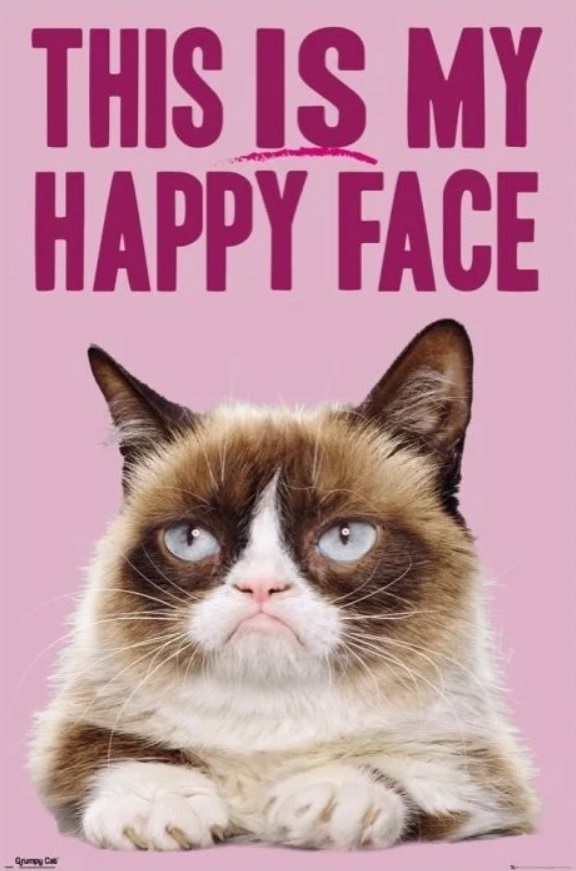
“More generally, such types of anthropocentric selection might lead to increased anthropomorphic tendencies. If, for example, the animal has the appearance of an expression which humans find relatable on some level, even if it is not necessarily reflective of that animals’ affective state, it may be used to attribute emotions or characteristics to them. For example, “grumpy cat” a cat made famous by her coverage on social media achieved her moniker due to her perceived “frowning” facial appearance. However, this was likely a result of a combination of her feline dwarfism and paedomorphic features, rather than an expression of her irritability.”

Flat faces negatively impact cats’ ability to communicate

Most of us know that flat-faced cat and dog breeds have breathing difficulties, but research by Finka et al (2020) found that “exaggerated” features may make it more difficult for pets to communicate with us.

Facial expressions help owners understand whether or not their pet is in pain. However, the researchers found that the “neutral faces of several of the brachycephalic breeds (e.g. Exotic short hairs, Persians and particularly Scottish folds)” showed more pain associated features “compared to the neutral expressions of most other breeds”. In fact,”[i]n the case of Scottish folds, their neutral facial landmarks indicated greater pain-like features even compared to the DSH cats that were actually in pain.”

These findings are potentially relevant when facial expressions are used to identify pain, especially in flat-faced breeds. This research suggests that facial expressions of domestic shorthair cats cannot be confidently applied to flat-faced breeds.

“The ability of companion animals to readily solicit care from humans is obviously advantageous. However, it is possible that permanently vulnerable looking individuals might have a diminished capacity to clearly indicate when care is or is not required, as well as to display other information relevant to their actual state or intentions. Thus, if certain cat breeds are being selected to display “pain-like” features on their faces, these features may serve to solicit unwanted or inadequate attention from their caregivers.”

“More generally, such types of anthropocentric selection might lead to increased anthropomorphic tendencies. If, for example, the animal has the appearance of an expression which humans find relatable on some level, even if it is not necessarily reflective of that animals’ affective state, it may be used to attribute emotions or characteristics to them. For example, “grumpy cat” a cat made famous by her coverage on social media achieved her moniker due to her perceived “frowning” facial appearance. However, this was likely a result of a combination of her feline dwarfism and paedomorphic features, rather than an expression of her irritability.”