Dirk update

At the end of September last year, Dirk was diagnosed with early stage kidney failure (CKD).

As he was still in the early phases of stage 1 we were quite optimistic we might be able to slow down the disease’s progression. This can be done mainly through diet and making sure the cat drinks enough. Dirk is not normally a fussy eater, but unfortunately he did not want to eat and of the various brands of kidney diet wet food. He does consistently eat the kidney fry food, but with wet food it’s a bit trial and error at the moment. He sometimes likes something for a few days and then goes off it again.

However, in late November/early December he was quite unwell and lost weight fairly rapidly.

Dirk had more tests done last month and sadly his CKD is progressing more rapidly than we’d like. He is now in the latter phases of stage 2.

As regards his behaviour, he no longer shows any interest in toys, but he remains very affectionate. We’ll enjoy as many cuddles as possible for as long as possible, but the time to say goodbye is coming closer.

Brushing your cat’s teeth

February is Pet Dental Awareness Month, an issue close to my heart as my own cat suffers from tooth resorption. All my blog posts this month will be dedicated to dental health in cats to highlight the importance of this issue. Today, I am re-posting this blog about brushing your cat’s teeth

Dental hygiene is as important for cats as people.
It helps keep your cat in great condition and prevents diseases (and a bad breath).

Still, you may feel a little unsure about brushing your cat’s teeth. I know I was a little taken aback when my vet first suggested brushing Dirk’s teeth.
He showed me ho
w to do it and – surprisingly – Dirk seemed fine with it.
However, trying it at home was a different story…   

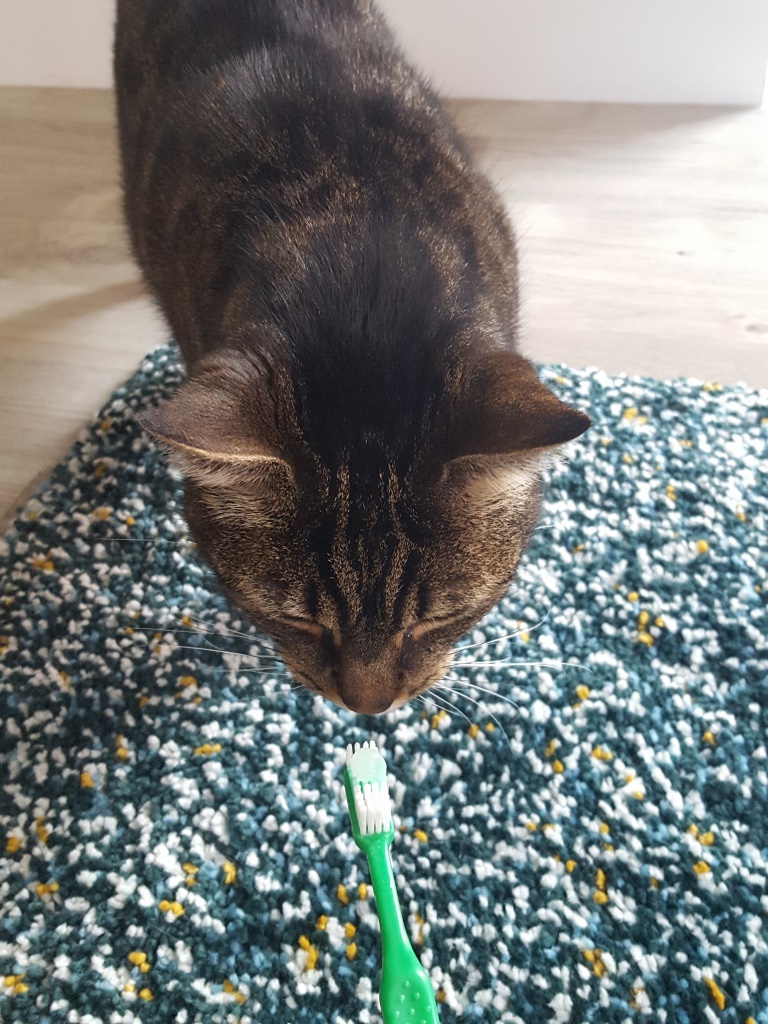
cat brushing teeth
If only it was this easy!


When I first started I was a bit too optimistic. Having seen the vet do it made me think it wouldn’t be so difficult. Dirk was not happy about it though. I tried every other day at first but I have to admit this soon became less frequent. Until Dirk was diagnosed with a dental disease called feline resorptive lesions.

After he had two teeth removed my mind set changed. I went from ‘I’ll try’ to ‘OK, I have to do this’.

Around this time I also started with my advanced feline behaviour course and was learning about learning theory and training cats. This was the perfect opportunity to put what I’d learnt into practice!

I took small steps to get Dirk used to having his teeth brushed. Admittedly, he still doesn’t like it. He tolerates it now although we have to odd day where he doesn’t. Those days are less frequent now, I brush his teeth most days. And afterwards he gets a special reward: his favourite treat which he goes nuts for.

The basics:

20190417_175628

  • First of all, buy toothpaste for cats. Toothpaste for people is toxic for cats, so never use this. Toothpaste for cats comes in tasty flavours such as chicken. Rest assured, even though it is tasty it also contains all the enzymes needed to clean your cat’s teeth.
  • Introduce your cat to the toothpaste. Let your cat lick the toothpaste off your finger (my cat loved it!). This allows the cat to get used to the flavour and texture and they will have a positive association with the toothpaste.
  • Once your cat is used to the toothpaste you can introduce a toothbrush, for example by letting your cat lick the toothpaste off the brush. There are several types of brushes designed for cats. Buy the one you feel most confident using.

Getting the job done:20190417_180510

  • Both you and your cat should be calm and comfortable before you start brushing your cat’s teeth.
  • Either sit behind your cat so they cannot escape or ask someone else to hold and soothe your cat.
  • Start by stroking and reassuring your cat. If you notice your cat becoming stressed, then don’t start brushing. Try again another day. If you turn this into a routine then your cat will become more relaxed over time and will allow you to brush their teeth.
  • Gently pull back your cat’s lips as shown in the picture.

What it looks like at the vet’s…        What it looks like at home
(Dirk prefers to lie down on his side)

  • Brush the teeth in slow circular motions and keep the bristles at a 45-degree angle. Brush the teeth and just beneath the gum margin, don’t brush the gums directly.
  • Brush as many teeth as the cat allows and praise your cat while doing so. Initially you may only be able to brush for about 10-15 seconds, but that’s a good start! When you’re more experienced and the cat has become more tolerant of having their teeth brushed you’ll be able to brush their teeth in about 1-2 minutes.

For more information please ask you vet or veterinary nurse.
For a video instruction, as well as additional information, please consult International Cat Care’s website.

“Suffering Dental Pain in Silence”: A Case Study

February is Pet Dental Awareness Month, an issue close to my heart as my own cat suffers from tooth resorption. All my blog posts this month will be dedicated to dental health in cats to highlight the importance of this issue.

* Adapted from katzenworld.co.uk

Skye, an 8-year old cat with a heart murmur, who came into the Bermondsey based clinic for an oral examination, is a typical case of advanced dental issues. Her gums were very inflamed and some of the teeth were broken due to ‘tooth resorption’ where the body’s own cells destroy tooth structure.

Dr. Campbell says: “Tooth resorption is a common dental disease in cats over 4 years of age and this case highlighted how much cat’s hide their pain particularly dental pain. Skye had a very healthy appetite and had no problems with eating or ‘hunting’. Her owner is a wonderfully observant and attentive carer but it is impossible to see this far back in the mouth of even the most malleable cat without a proper oral examination by your vet or nurse.”

Dr. Campbell recommended that Skye come in for a Comprehensive Oral Health Assessment and Treatment (COHAT)*. First, he performed a non-invasive cardiac ultrasound (echocardiography) and chest radiographs (x-rays) to investigate the cause of Skye’s heart murmur and to assess risks prior to a general anaesthetic. She was found to have structural changes in the left side of her heart but was considered to be low risk for an anaesthetic adverse event. Skye’s anaesthetic protocol was tailored to her conditions and designed to keep her heart rate nice and relaxed and lungs well oxygenated. She was placed into an oxygen tent for 30 minutes before her anaesthetic to allow her to take in the very rich oxygenated air.

The clinic’s nurses use a multi-parameter monitor for constant monitoring of the heart rate, body temperature, blood pressure and breathing (capnography) allowing any alterations to be made minute-by-minute. Dental nerve blocks were used, which reduce intra and post-operative pain and the amount of overall general anaesthetic required which is even better for the heart. Full mouth x-rays were taken which are essential to determine disease below the gumline and a dental chart was completed recording all details for every tooth. Skye had four teeth removed in total, and is now making a good recovery.

* Full details about COHAT available here: http://www.thelondoncatclinic.co.uk/cohats-comprehensive-oral-health-assessment-and-treatments/

Vet Warns That Cat Population is “Suffering Dental Pain in Silence”

February is Pet Dental Awareness Month, an issue close to my heart as my own cat suffers from tooth resorption. All my blog posts this month will be dedicated to dental health in cats to highlight the importance of this issue.

* Originally published by katzenworld.co.uk

Around 85% of cats aged over three suffer from some degree of dental disease, and regular brushing of the pet’s teeth can help, says a leading London-based feline vet.

Dr. Jeremy Campbell, Clinical Director at The London Cat Clinic, one of only a handful of practices in the UK that is cat-only, recommends tooth brushing together with 6-monthly to yearly dental checks to spot disease early. This can help prevent the formation of tartar, which can slow the progression of diseases such as gingivitis and periodontitis.

Dr. Campbell explains: “One thing that pet owners can do at home to help reduce the progression of dental disease in their cat is brushing the teeth regularly where possible. This isn’t easy with cats and they need to be trained from kitten-hood but it is possible.

“Owners are often under the impression that feeding 100% dry food will ‘clean’ their teeth sufficiently. However, recent studies have shown that regular dry food has little abrasive qualities, as cats tend to chew too quickly for any real impact. Any effect it has is at the tip of the tooth and most diseases in cats are at the gum level or below the gum line much higher up.”

The London Cat Clinic offers a Comprehensive Oral Health Assessment and Treatment (COHAT), including dental radiography.*

A further problem contributing to “the silent suffering”, explains Dr. Campbell, is that cats also tend to ‘hide’ dental disease from their owners, so dental disease may go undiagnosed until the animal is more likely to be in severe pain.

Symptoms include lethargy, decreased appetite, bad breath and inactivity. Left untreated, dental disease can affect the organs, causing damage to the kidney and liver.

Many pet owners are also concerned about the risks of subjecting their pet to a general anaesthetic – particularly if they have an existing medical condition.

Dr. Campbell says: “Pet owners whose cats have underlying diseases or are elderly are often reluctant to bring in their cats in for a dental examination, as they are concerned that their cat will not be a good candidate for general anaesthetic. Often, however, this is not the case. We carry out checks appropriate to their age and any existing problems to allow us to assess risks and to plan accordingly.”

He added: “Cats should ideally have their teeth examined by a vet or nurse at least once every 12 months. Cats that have had dental problems should be examined once every 3-6 months depending on their condition.

“Generally, the sooner the problem is identified, the easier and quicker it is to treat. Even if the cat’s mouth is being examined every day, dental disease will develop and gradually progress. Cats will quite often not show clinical signs until the disease is advanced, by which time many teeth may need to be extracted.”

Top Tips for Keeping Your Pet’s Heart Healthy

* From my partners at katzenworld.co.uk

The heart is one of the most important organs in the body, not only for humans, but for our furry family members too. It’s therefore crucial to keep it strong and healthy – anything that stops the heart from functioning as normal, such as changes in size, shape or rhythm, can cause problems.

PDSA Vet Nurse, Nina Downing, said “Heart problems can be fairly common and cause a wide range of symptoms – some animals can live with a heart condition for years with minimal impact on their life, while others may have severe, life-threatening symptoms. There are several things you can do to support the heart health of your four-legged friend.

Watching out for symptoms 

“There are important signs of heart disease to look out for in pets which, sadly, may worsen over time. While heart disease can’t be cured, there are treatments which can help to manage your furry family member’s symptoms and slow the progression of the disease. Things to look out for include your pet stopping or slowing down while exercising, breathing faster than normal when they are sleeping, taking a while to catch their breath after exercise, low energy, panting for longer or more often, coughing or, for cats in particular, breathing with an open mouth.  Pets struggling with a heart condition may also collapse.

Maintaining a healthy weight 

“If your furry family member is carrying extra weight, their heart has to work harder, which adds a lot of strain. Making small changes, such as weighing out their food, cutting back on unhealthy treats, and not giving in to puppy dog eyes at the table, are small changes you can make to help them maintain a healthy weight. Talk through any concerns about your pet’s weight with your vet – they may suggest a weight clinic to help support you.

Getting enough exercise 

“Exercise is a key part in keeping your pet’s heart healthy. Making sure your pooch is going for daily walks, suitable for their size, weight, and fitness ability, is really important. In between walks, have fun and play games together to help keep dogs moving.

“Cats enjoy playtime too – even if your cat is active and enjoys roaming outdoors, they will still enjoy special time with you, which will motivate them to exercise, and it’s great for bonding. If they are slightly overweight or more reluctant to move around, short play sessions are a great way to introduce a new exercise regime. You can increase the length of activities, as your cat gets fitter and more enthusiastic.

“Engaging your cat with toys, such as balls, teaser toys, wind-up chase toys, will also encourage their natural hunting instincts.

Regular vet checks  

“Catching heart problems early can make a big difference to your furry family member’s long-term health. Regular check-ups with the vet, where they can listen to your pet’s heart, can help pick up a problem before it develops.

“If you are concerned about your pet’s health, or they display any worrying symptoms between check-ups, always book an appointment so your vet can offer advice and treatment to keep your pet happy and healthy.”