Wishing everyone joy and happiness during the Holiday season.
It will be a special season for us as Dirk has not been doing too well. We’re extra grateful to still have him with us and cherishing our time with him.
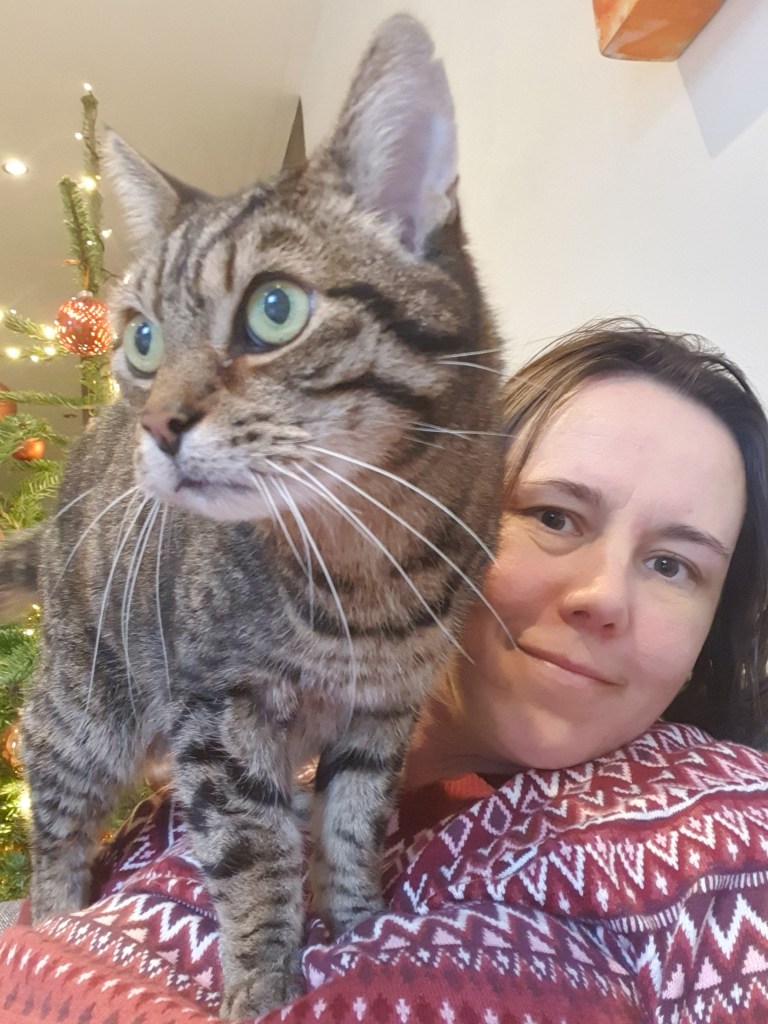

Wishing everyone joy and happiness during the Holiday season.
It will be a special season for us as Dirk has not been doing too well. We’re extra grateful to still have him with us and cherishing our time with him.
* Adapted from Anna Ford’s article for the University of Sussex’s News Broadcast
A team of psychologists at the Universities of Sussex and Portsmouth have shown for the first time that it is possible to build rapport with a cat by using an eye narrowing technique with them.
This eye narrowing action by humans generates something popularly known as a cat smile – the so called “slow blink” – and seems to make the human more attractive to the cat.
The study found:
To read the full article, click here.
* Originally published by ProtectaPet
“In 1963, Jean S. Mill crossed the domestic cat with the Asian Leopard Cat, a spotted, five to twelve pound, shy non-domestic cat species from Asia. This was the first effort to use hybrid offspring to create a breed of domestic cat with the loving nature of the best fireside tabby and the striking look of Leopards, Ocelots and Jaguars.”
Cat Fanciers Association.
It wasn’t until the 1980’s that the modern bengal cat we know and love today emerged thanks to Jean S. Mill in the United States. This newer breed then became regonised by the GCCF in 1997.
The Bengal takes on many visible characteristics of it’s wild ancestors. Bengals are muscular in stature and they carry their tails low like an undomesticated cat would. Females are significantly smaller than males but both feature beautiful broad wedge-shaped heads and friendly expressions. With cheek bones to die for, the cutest whisker pads and a strong broad muzzle all contributing to their wild appearance.
The Bengal coat is short to medium and very soft. Bengals come in a wide variety of patterns and colours, one of the most popular being the “Rosetted Bengal“, where their spots are a contrasted two-toned colouring.
As well as spotted bengals, they can also have a marbled, swirly pattern.

If you’re looking for a companion you can pick up and stroke for hours on end then the Bengal is not for you.
Bengals can be quite mischievous and they love to play. They need lots of toys and entertainment to keep their intelligent brains occupied. Bengal cats have a good set of lungs and they love to be vocal. You’ll be told if they’re hungry, if they’re not happy with the state of their litter tray or anything else that might not be pleasing them. They can be quite fussy and they are not shy in conveying their feelings through meows.
Bengals Form Close Bonds
While they are vocal and love to play, Bengals are very affectionate. Playing with your cat will help to form a close bond but don’t be surprised if they select one of the family to form an extra special friendship with.
Many people think Bengals are more aggressive than other breeds, but this is false. Bengals are the same as other domestic breeds. They need to be socialised from a young age in just the same way as other cats to avoid behavioural problems.
French research published in Animal Cognition has found that your cat recognises when you are talking to them. Most people use a different tone or pitch when speaking to their cat as compared to speaking to other people. Cats recognise the difference, but this does not necessarily mean they will listen…
The researchers found that cats respond to their owners’ cat-directed speech; they don’t respond to a stranger’s cat-directed speech.
This implies that the bond a cat has with a person influences their behaviour and highlights the importance of relationships between cats and their owners.
To find out more click here to access the full article.
* Originally published by ProtectaPet
The ProtectaPet Cat Balcony Kit enables apartment-dwelling cat owners to provide safe, supervised, outdoor access for their cat.
International cat fencing specialist, ProtectaPet, has launched its latest product in the modular range of cat fencing products – the ProtectaPet Cat Balcony Kit – a unique way of keeping cats safe on balconies.

The risk of cats falling from balconies is highly publicised. Animal welfare charity, the Blue Cross, appealed to cat owners to keep cats safe around elevated open windows and balconies after two cat fatalities and five cat injuries were treated one summer weekend at their Victoria animal hospital in 2017. In New York, the term ‘high rise syndrome’ was coined when one hot summer in the 1980s more than 100 cats were brought into a veterinary center with injuries from falls.
For high-rise cat-owners with balconies, the choice has been stark, with most cats kept indoors for their own safety. While thousands of cats in the UK live in apartments, many of them don’t have access to fresh air, with windows and doors being deliberately kept shut to ensure their safety.
Product designer and Managing Director of ProtectaPet, Simon Davies BSc, challenged himself to design a balcony enclosure that was adaptable to different balcony configurations. The clever design allows multiple sections to be joined together inline or at ninety degrees. The modular screen can be used on one sided balconies or expansive balconies with multiple sides. The netting is made from hybrid stainless-steel reinforced nylon for resistance to chewing, while maintaining a low visual impact.
The ProtectaPet Cat Balcony Kit has been in development for three years, having undergone extensive product testing. It is the first Cat Balcony Kit of its kind with ‘no drill’ attachments. This is because most people living in balconies are prohibited from drilling into the masonry or attaching anything permanent to the exterior of the building. Crucially, the innovative new fixtures are secured under tension, enabling owners to easily relocate the balcony enclosure if they move.

Simon says, ‘We are really excited to launch this solution for cat owners’ peace of mind about their cat’s welfare and safety. No more worrying about smelly cat litter trays and keeping the balcony doors shut either! The DIY kit can be installed with a hacksaw, hammer, pliers and scissors, making it accessible to most practical people. It requires two people for installation, and they must undertake a rigorous risk assessment to ensure the safety of themselves and those around them.’
ProtectaPet say that the target market for this new product is cities with high rates of cat ownership in the UK and across all of Europe. They are noticing ‘hot-spots’ of enquiries from places like St Helier in Jersey, presumably because once one cat owner has discovered the product, news spreads and subsequently their cat-owning neighbours are interested. It is designed and made in Britain with ambition for international clientele.
 happycats.london