Research by Finka et al (2022) has demonstrated that many ‘cat people’ tend to pet their cats in areas the cat does not like. Their tummy being one such example. I know a cat’s tummy is soft and it is tempting to give them a tummy rub, but the vast majority of cats do not like this and will scratch you. When they lie on their backs it is a sign of trust, not an invitation to pet them. In fact, petting the tummy could be perceived as a betrayal of that trust.
From the researchers:
“Tactile interactions with cats are considered to have therapeutic benefits to humans and are increasingly included within interventional contexts to improve human wellbeing. However, cats are not considered an inherently social or highly tactile species and may have specific preferences for the ways in which they like to be touched and interacted with. Despite this, the common occurrence of human-directed aggression during interactions suggests humans’ understanding of cat behaviour and appropriate styles of interactions with cats may be limited. To address this, in a recent study, we incorporated expert understanding of ‘best practice’ styles of interactions with cats into an educational intervention for humans to use during unstructured social interactions with cats. By encouraging humans to engage in styles of interactions with cats which provided the cat with greater levels of autonomy and also emphasised focusing on the cat’s behaviour and comfort, cats responded with increased human-directed affiliative and positively-valanced behaviour, in addition to decreased rates of human-directed aggression and signs of negative affect.”
Reasearch by Humphrey et al (2020) has confirmed what many cat owners already suspected: narrowing your eyes is the best way to build a rapport with cats.
Their study found that “cats respond to a human giving a slow blink stimulus by producing eye narrowing movements of their own”.
“Firstly, cats deliver more eye narrowing movements when their owners slow blink at them than when the owner is present in the room but not delivering this stimulus.”
“Secondly, when an unfamiliar experimenter gives the slow blink stimulus compared to adopting a neutral face, cats respond with a higher frequency of eye narrowing movements themselves.”
Their study also found that cats were more likely to approach people after slow blinking as opposed to having a neutral face.
“From the current study, the slow blink sequence appears to be an indicator of positive emotion in cats.”
Cats are also known to initiate a sequence of slow blinking with humans. The slow blinking behaviour may well be innate behaviour but could also be a result of domestication.
“It could be argued that cats have developed slow blink behaviours because humans appear to perceive slow blinking as positive and cats may have previously been reinforced by their owners for responding to slow blink sequences.”
“It is also possible that slow-blinking in cats originated as a mechanism to interrupt an unbroken stare, which is potentially threatening in social interactions; this could then have been elaborated by a combination of selection and learning in the domestic environment.”
“Socio-cognitive abilities of cats are an under-studied area, and future research on cat behaviours, such as slow blinking, could enhance our understanding of interspecific communication and the ways in which domestication has shaped the social behaviour of an ancestrally solitary species.”
I feel like I should preface this by telling you that what follows is probably going to be the weirdest contact you’ve ever received, and it’s definitely the weirdest contact I’ve ever sent. I apologize in advance for literally everything I’m about to tell you.
My name is Jessica Gerson-Neeves, and my wife Nikii Gerson-Neeves and I have coveted a Vitamix for several years now, as I have a chronic disease that makes fiber very difficult for me to digest and my wife is an avowed lover of smoothies. Black Friday sales offered us the opportunity we hadn’t found earlier, and we finally ordered a Vitamix from Amazon the day after Thanksgiving. We were quite delighted when it arrived on our doorstep several weeks ago, and immediately brought it inside and absently set it down on the kitchen floor “just for a quick second.” That was our first mistake, and this is where things get weird.
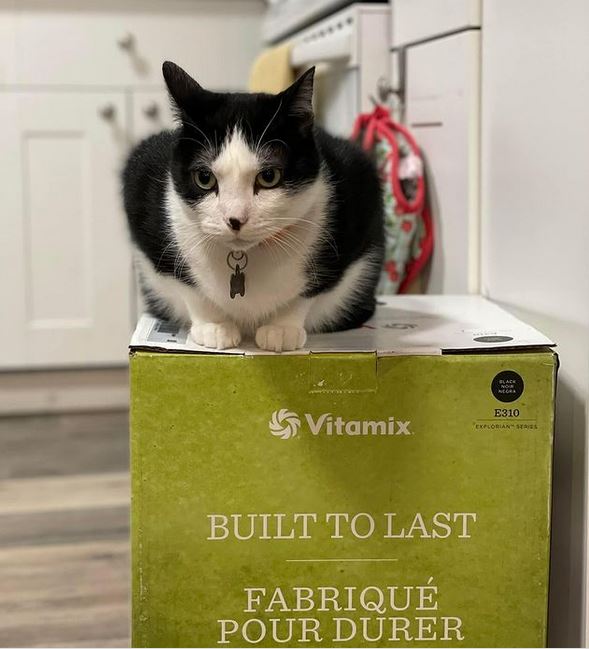
We are the devoted servants of a trio of cats who go by the names of Max; George, Destroyer of Worlds; and Lando Calrissian. Mere seconds after setting down the Vitamix box, in the moments before we would’ve opened it and happily put our exciting new blender to use, Max (also known as the sentient soccer ball) spotted the box and, assuming it was for him, hopped right up on top.
And that was the beginning of the end.
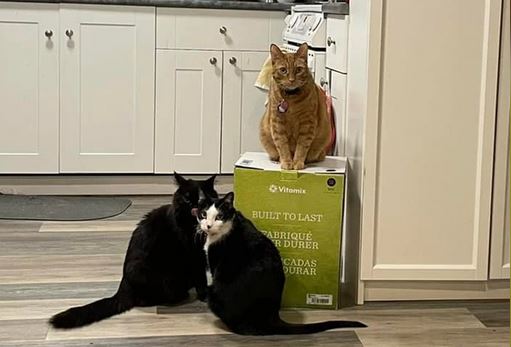
That moment was two and a half weeks ago, and since then, the Vitamix box has been occupied by at least one and sometimes two cats at all times. With three cats and only two humans in the household, the humans are outnumbered and (being giant suckers), both frightened of and unwilling to forcibly relocate the offending cats.
Yes, we realize we’re absolute madwomen, and yes, we are both ashamed and sorry.
Long before we realized what this would turn into, I snapped a picture of Max atop the Vitamix that first day and posted it to a cat group on Facebook that goes by the name of THIS CAT IS C H O N K Y. The group boasts nearly a million members, and the post immediately took off. Since then, I have been faithfully documenting the whole sordid saga each day with photographs and accompanying prose. I am attaching to this email a curated selection of these posts and the pictures that accompany them so that you can get a sense of how the situation, now known widely as The Great Vitamix Incident of 2021 and/or Appliancegate, has developed.
Incidentally, I should mention here that of the five-to-ten thousand people following the saga, we are aware of at least a few who have now ordered their own Vitamixes, and hundreds of them are now seeing targeted ads for Vitamixes (Vitamices? We’re not quite sure of the appropriate pluralization). You’re welcome for the deeply strange free publicity?
We write to you because it has become clear at this point that without herculean intervention, we’re never going to get to use the new blender we’ve been longing for for years. Despite what many people have suggested, we aren’t writing to request additional Vitamixes—that would be ridiculous, and while we’re definitely ridiculous, we’re not quite that ridiculous.
No, we’re writing with a stranger but far less expensive request. Is there—I cannot believe I am honestly asking this—any possibility at all that y’all would be willing to send us three (the number is very important, as there are three cats and we need there to be one extra so we can hopefully get the actual blender out of the box) empty Vitamix boxes? Other cardboard boxes seem to lack the appeal of the Vitamix box, and since, much like your wonderful blenders, this stand-off seems to be Built To Last, we’re afraid that this may be our only way out of the situation in which we find ourselves.
In case you are wondering, yes, I am ashamed of both writing and posting this letter. I both dread and look forward to hearing your response, and encourage you (as I’m sure you are finding yourself with the urge to do so) to spread it to your colleagues as widely as you would like in order to laugh at the absolutely bonkers middle-aged lesbians who are losing a stand-off with their cats.
Yes, we are a stereotype.
If by some miracle you are actually willing to fulfill the weirdest request ever, please let us know and I will be happy to send along our mailing address. And if, by some miracle, you have the urge to use any of the pictures, (which I have censored, I apologize for my foul mouth) posts in your marketing, at least let us know in advance, so we’re aware that more of the world is going to witness our shame.
With desperation and many, many apologies,
Jessica Gerson-Neeves
Vitamix reply:
Thank you for reaching out. This issue is not one to be handled lightly. We’ve assessed your predicament and have come to the following conclusion.
Firstly, we’re firm believers that you cannot move a cat from its post. Doing so results in penultimate despair.
Secondly, our great engineers designed these boxes for ultimate protection of the Vitamix unit. Little did they know, the possibility of a chonkier unit atop the unopened box would pose a problem. We’ll chat with them later. 😉
Thirdly, we’ve contacted our support team to stop what they’re doing and #SENDTHEBOXES. 🌈
Send us a private message when you get a chance so we can get your contact information over to our team.
I remember the scene vividly as it happened every time my grandmother visited: as soon as my grandmother entered the front door the cat disappeared from the living room. This left my grandmother disappointed as she loved cats. The only time the cat did not leave in time my grandmother rushed over only to be confronted by a cat turning its back on her.
Conversely, cats tend to approach those people that do not want to interact with them at all. Why?
Well, precisely because these people do not seek any contact. This means the cat is in control of the interction. About whether or not it happens and how long it will last. The ‘non cat person’ is far more likely than the ‘cat person’ to accept a cat’s boundaries and need for space.
Click here for the research study if you’d like to find out more.
Research by Takagi et al (2021) has found evidence that cats track their owners movements.
As Linda Geddes reports in The Guardian “cats appear to track their owners as they move about the house and are surprised if they turn up somewhere they’re not expecting them.”
“The finding supports the idea that cats retain a mental representation of their owners, even when they can’t see them; a crucial bridge to higher cognitive processes such as forward planning and imagination.”
“Cats are notoriously inscrutable creatures. Although previous research has suggested that cats will search in the correct place if food is seen to disappear, and expect to see their owner’s face if they hear their voice, it was unclear how this ability translated into real life. “It is [also] said that cats are not as interested in their owners as dogs are, but we had doubts about this point,” said Dr Saho Takagi at the University of Kyoto, Japan.” I could not agree more and I suspect many cat owners agree with that. My own cat often greets me at the door and can’t get close enough to me when I’ve been away for a few days.
“This study shows that cats can mentally map their location based on their owner’s voice,” said Takagi, whose research was published in the journal PLOS One. “[It suggests] that cats have the ability to picture the invisible in their minds. Cats [may] have a more profound mind than is thought.”
“However, it’s not entirely surprising that cats possess this ability: “That awareness of movement – tracking things they cannot see – is critical to a cat’s survival,” said Roger Tabor, a biologist, author and presenter of the BBC TV series Cats.”However, it’s not entirely surprising that cats possess this ability: “That awareness of movement – tracking things they cannot see – is critical to a cat’s survival,” said Roger Tabor, a biologist, author and presenter of the BBC TV series Cats.”
“A lot of what a cat has to interpret in its territory is an awareness of where other cats are. It is also important for hunting: how could a cat catch a field vole moving around beneath the grass if it couldn’t use clues, such as the occasional rustle, to see in its mind’s eye, where they are? A cat’s owner is extremely significant in its life as a source of food and security, so where we are is very important.”


 happycats.london