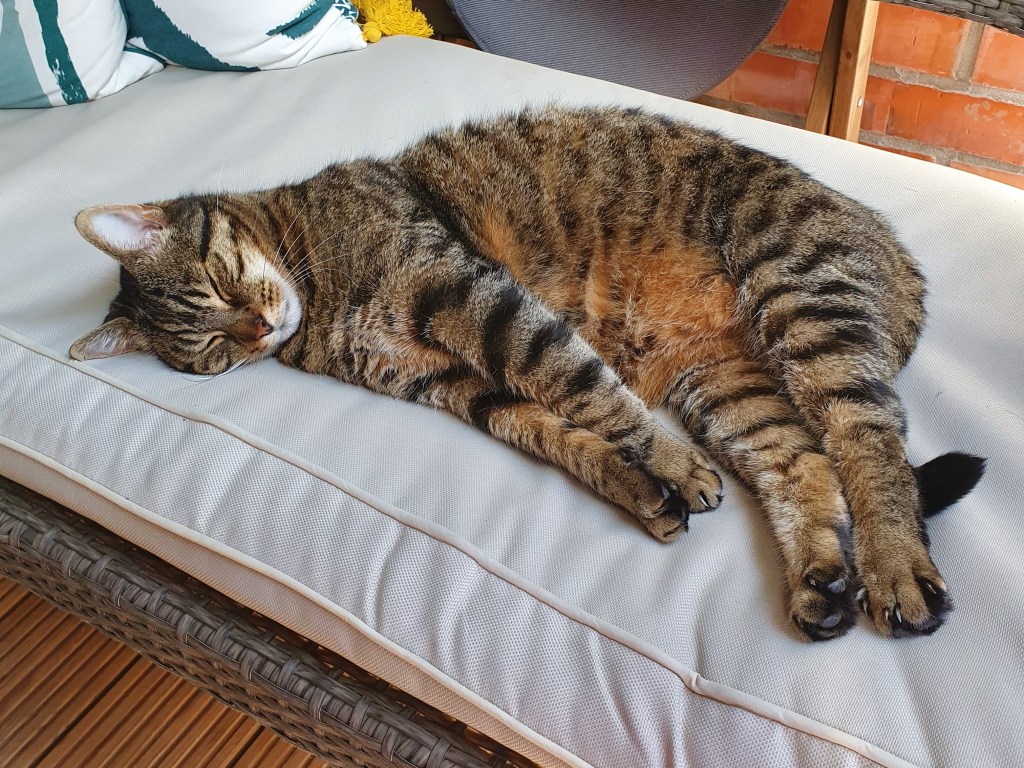
Dirk the Rocket Cat

* Originally written by me for katzenworld.co.uk

The MelloCat Rocket Roller is one of those toys I wasn’t quite sure of initially. I mean, it looks like a rocket (complete with take-off smoke) which is sort of cool. But rockets and cats?

Once again, Dirk took me by surprise and was immediately taken with this toy.
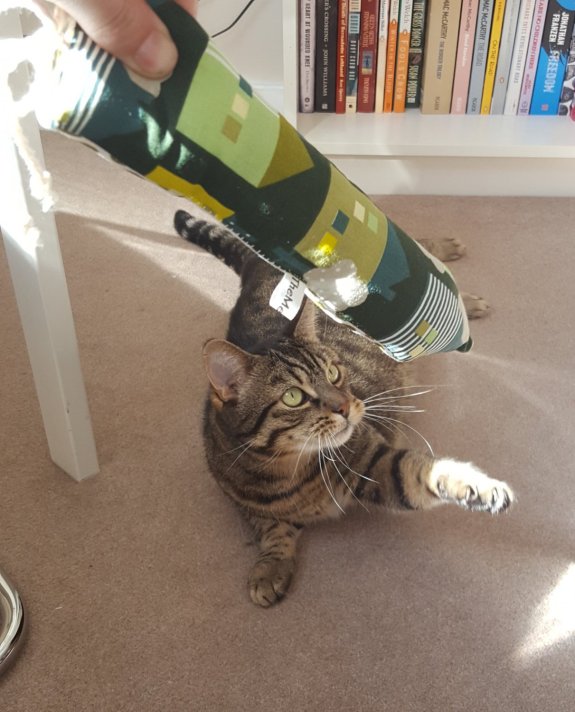
Rocket-1.1
Give me that, I know it’s for me!

I’m sure you all know what Dirk is going to do with this toy! Yes, that’s right: give it a good kick 😉 And he can be really quite ferocious when kicking it so this is a proper workout for his hind legs. The toy is quite large: he can easily grab hold of one side and then kick the other side of the rocket.
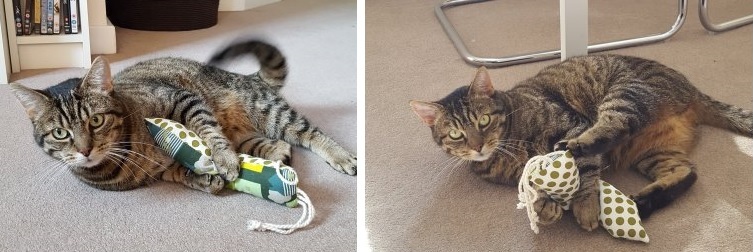
Rocket-2-4

My favourite thing is to send it ‘flying’ through the house so Dirk can go and chase it. He doesn’t really let go of this toy very easily though. I guess he’s happy he’s our only cat because sharing toys would be a serious problem…

Rocket-3
Look at me and my cool rocket! We’re totally going places 🙂
(No, not really Dirk, you just look silly)

The MelloCat Rocket Roller is handmade and it looks amazing. It’s really well made and quite sturdy, it can take a lot of kicks! Cats that love kicking toys and want to look cool doing it: this is your toy 🙂

Rocket-5.1
Going to take a nap now, but don’t even think you can have the rocket back now!
Why do cats chatter their teeth when they spot prey?

Many owners will have heard and seen their cat chattering when they spot prey. Indoor cats do it too even if they have never hunted.
So why do they do this? Is it because they can’t get to the prey?

In fact, this is normal hunting behaviour. Your cat’s instincts are kicking in – even if they have never hunted they still have those instincts. Experts used to believe cats were excited or frustrated when they chatter or that they were mimicking their prey’s sounds. Cats hunt for a large variety of prey, though, and most of them sound nothing like a cat’s chattering.
Most experts now think that the chattering jaw movements are similar to the killing bite. Your cat is eagerly anticipating having a good bite.

Perhaps we can satisfy indoor cats by giving them a toy to chase & catch after the prey has left and give the cat a treat 😉

I think the noise is very funny. I laugh whenever I hear Dirk do it and it’s usually when he sees birds nearby (pigeons seem to love teasing him by sitting on the balcony railing).


Problem-solving ability and laterality in cats

I started teaching Dirk to give paw a few months ago and we have now progressed to one knock = right paw and two knocks = left paw. Of course he makes mistakes occasionally, but overall he is pretty good at giving me the paw I’m asking for.

When I first started training Dirk I noticed he has a slight preference to use his left paw. He would always use that oe first and also uses it most frequently. He also uses his left paw most when playing with his puzzle feeders (though he does switch to right paw as well).

Intrigued by his paw preference I started looking into research about domestic cats and left- or right-pawedness and found a very interesting research paper on this topic. Obviously, food was involved in testing the cats as participation needs to be rewarding for them too 😉 However, even that could not convince all cats to participate as 3 out of 41 cats tested did not move a paw at all. Of the other 38 cats, 10 were right-pawed, 12 left-pawed and 16 were ambilateral: they showed no preference for either left or right paw.

The study showed that cats with a clear paw preference, either left or right, were better at solving the food puzzles than those cats that did not have a paw preference. The cats with a paw preference found their way to the food a lot quicker with fewer paw movements.

The researchers discovered that domecats actually preferred opening the food puzzles with their head rather than paw. Those that had a head preference opened fewer sections of the puzzle feeder than those with a paw preference. This means that cats that perfer to use their paws possibly have better motor skills and problem-solving skills than those that prefer using their heads. One possible explanation that some cats have a head preference may be related to domestication: we tend to feed our cats from bowls which does not require any motor skills from the cat.

Does it matter whether a cat is left-pawed or right-pawed, ambilateral or prefers to use their head? In a domestic cat probably not, but perhaps this research gets us one step closer to proving just how intelligent cats are 😉

Left-pawed or right-pawed, just stretch them all

Will my cat use their new bed?

Many owners buy things for their cat and then their cat doesn’t use them! Cat beds are one such example. How do you know if your cat will decide to use it? Cats often prefer to sleep in elevated places, so position of the cat bed can make a difference. Not all cats sleep in their bed when it is on the floor, but you will increase the chances of your cat using it if you place it on top of a dresser, for example. They also enjoy igloo style beds as this increases their sense of security.

Another thing many cats absolutely love is sheepskin! A small sheepskin rug is a very nice, warm and comfortable bed. And it is flexible too, in the sense that you can put it where you like. You can leave it on the floor or sofa during the day and next to your bed, on your bed or the dresser at night. This means you won’t need many cat beds, just the one rug that you leave in one place or move around the home depending on where you want your cats to spend the night.