Reasearch by Humphrey et al (2020) has confirmed what many cat owners already suspected: narrowing your eyes is the best way to build a rapport with cats.
Their study found that “cats respond to a human giving a slow blink stimulus by producing eye narrowing movements of their own”.
“Firstly, cats deliver more eye narrowing movements when their owners slow blink at them than when the owner is present in the room but not delivering this stimulus.”
“Secondly, when an unfamiliar experimenter gives the slow blink stimulus compared to adopting a neutral face, cats respond with a higher frequency of eye narrowing movements themselves.”
Their study also found that cats were more likely to approach people after slow blinking as opposed to having a neutral face.
“From the current study, the slow blink sequence appears to be an indicator of positive emotion in cats.”
Cats are also known to initiate a sequence of slow blinking with humans. The slow blinking behaviour may well be innate behaviour but could also be a result of domestication.
“It could be argued that cats have developed slow blink behaviours because humans appear to perceive slow blinking as positive and cats may have previously been reinforced by their owners for responding to slow blink sequences.”
“It is also possible that slow-blinking in cats originated as a mechanism to interrupt an unbroken stare, which is potentially threatening in social interactions; this could then have been elaborated by a combination of selection and learning in the domestic environment.”
“Socio-cognitive abilities of cats are an under-studied area, and future research on cat behaviours, such as slow blinking, could enhance our understanding of interspecific communication and the ways in which domestication has shaped the social behaviour of an ancestrally solitary species.”
I feel like I should preface this by telling you that what follows is probably going to be the weirdest contact you’ve ever received, and it’s definitely the weirdest contact I’ve ever sent. I apologize in advance for literally everything I’m about to tell you.
My name is Jessica Gerson-Neeves, and my wife Nikii Gerson-Neeves and I have coveted a Vitamix for several years now, as I have a chronic disease that makes fiber very difficult for me to digest and my wife is an avowed lover of smoothies. Black Friday sales offered us the opportunity we hadn’t found earlier, and we finally ordered a Vitamix from Amazon the day after Thanksgiving. We were quite delighted when it arrived on our doorstep several weeks ago, and immediately brought it inside and absently set it down on the kitchen floor “just for a quick second.” That was our first mistake, and this is where things get weird.
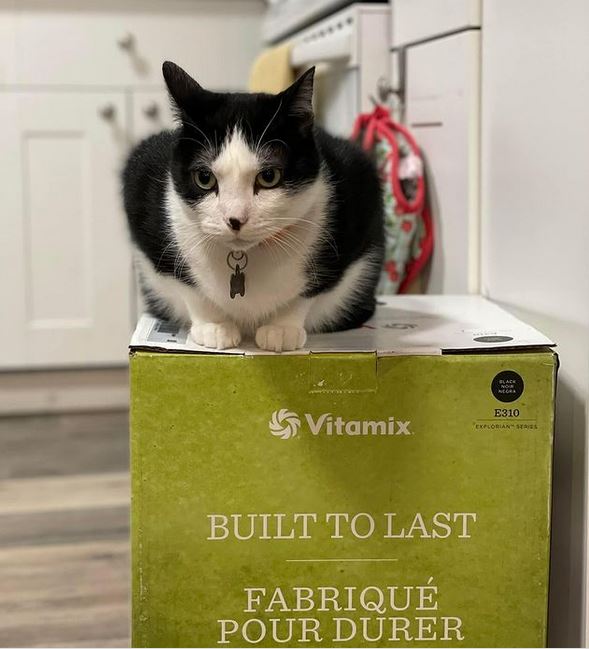
We are the devoted servants of a trio of cats who go by the names of Max; George, Destroyer of Worlds; and Lando Calrissian. Mere seconds after setting down the Vitamix box, in the moments before we would’ve opened it and happily put our exciting new blender to use, Max (also known as the sentient soccer ball) spotted the box and, assuming it was for him, hopped right up on top.
And that was the beginning of the end.
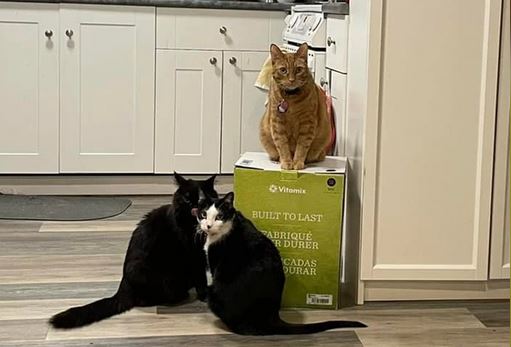
That moment was two and a half weeks ago, and since then, the Vitamix box has been occupied by at least one and sometimes two cats at all times. With three cats and only two humans in the household, the humans are outnumbered and (being giant suckers), both frightened of and unwilling to forcibly relocate the offending cats.
Yes, we realize we’re absolute madwomen, and yes, we are both ashamed and sorry.
Long before we realized what this would turn into, I snapped a picture of Max atop the Vitamix that first day and posted it to a cat group on Facebook that goes by the name of THIS CAT IS C H O N K Y. The group boasts nearly a million members, and the post immediately took off. Since then, I have been faithfully documenting the whole sordid saga each day with photographs and accompanying prose. I am attaching to this email a curated selection of these posts and the pictures that accompany them so that you can get a sense of how the situation, now known widely as The Great Vitamix Incident of 2021 and/or Appliancegate, has developed.
Incidentally, I should mention here that of the five-to-ten thousand people following the saga, we are aware of at least a few who have now ordered their own Vitamixes, and hundreds of them are now seeing targeted ads for Vitamixes (Vitamices? We’re not quite sure of the appropriate pluralization). You’re welcome for the deeply strange free publicity?
We write to you because it has become clear at this point that without herculean intervention, we’re never going to get to use the new blender we’ve been longing for for years. Despite what many people have suggested, we aren’t writing to request additional Vitamixes—that would be ridiculous, and while we’re definitely ridiculous, we’re not quite that ridiculous.
No, we’re writing with a stranger but far less expensive request. Is there—I cannot believe I am honestly asking this—any possibility at all that y’all would be willing to send us three (the number is very important, as there are three cats and we need there to be one extra so we can hopefully get the actual blender out of the box) empty Vitamix boxes? Other cardboard boxes seem to lack the appeal of the Vitamix box, and since, much like your wonderful blenders, this stand-off seems to be Built To Last, we’re afraid that this may be our only way out of the situation in which we find ourselves.
In case you are wondering, yes, I am ashamed of both writing and posting this letter. I both dread and look forward to hearing your response, and encourage you (as I’m sure you are finding yourself with the urge to do so) to spread it to your colleagues as widely as you would like in order to laugh at the absolutely bonkers middle-aged lesbians who are losing a stand-off with their cats.
Yes, we are a stereotype.
If by some miracle you are actually willing to fulfill the weirdest request ever, please let us know and I will be happy to send along our mailing address. And if, by some miracle, you have the urge to use any of the pictures, (which I have censored, I apologize for my foul mouth) posts in your marketing, at least let us know in advance, so we’re aware that more of the world is going to witness our shame.
With desperation and many, many apologies,
Jessica Gerson-Neeves
Vitamix reply:
Thank you for reaching out. This issue is not one to be handled lightly. We’ve assessed your predicament and have come to the following conclusion.
Firstly, we’re firm believers that you cannot move a cat from its post. Doing so results in penultimate despair.
Secondly, our great engineers designed these boxes for ultimate protection of the Vitamix unit. Little did they know, the possibility of a chonkier unit atop the unopened box would pose a problem. We’ll chat with them later. 😉
Thirdly, we’ve contacted our support team to stop what they’re doing and #SENDTHEBOXES. 🌈
Send us a private message when you get a chance so we can get your contact information over to our team.
I remember the scene vividly as it happened every time my grandmother visited: as soon as my grandmother entered the front door the cat disappeared from the living room. This left my grandmother disappointed as she loved cats. The only time the cat did not leave in time my grandmother rushed over only to be confronted by a cat turning its back on her.
Conversely, cats tend to approach those people that do not want to interact with them at all. Why?
Well, precisely because these people do not seek any contact. This means the cat is in control of the interction. About whether or not it happens and how long it will last. The ‘non cat person’ is far more likely than the ‘cat person’ to accept a cat’s boundaries and need for space.
Click here for the research study if you’d like to find out more.
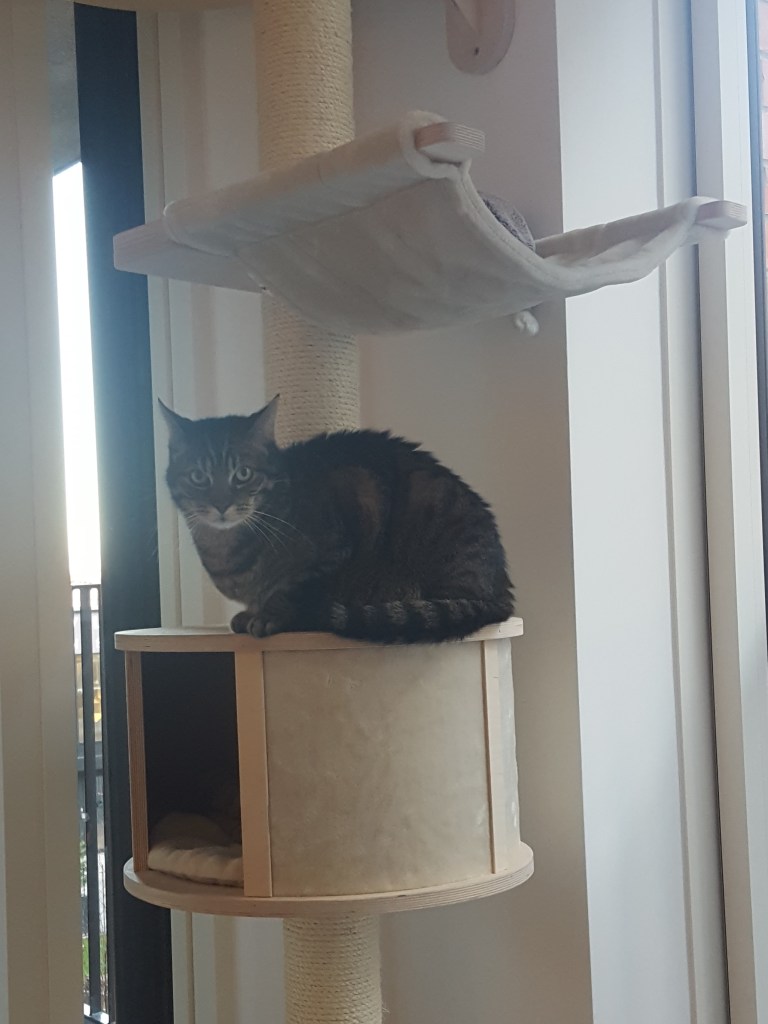
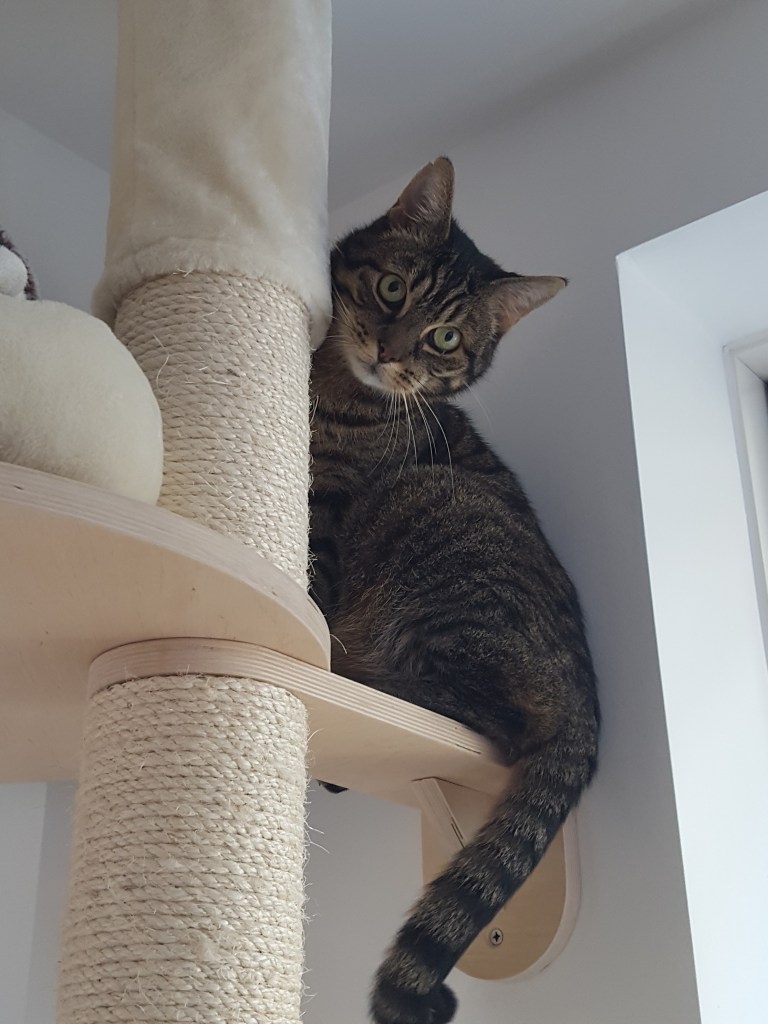
Building a cat tower requires doing some research and understanding your cat’s behaviour. It’s not an easy task. In fact, there may be instances where you build one, only to tear it down after you’ve seen how your cat is using it.
Here are some tips for building the best cat tower for your pet.
1. Research
It’s always a good idea to do some research on any project that you set your eyes on. Take some pictures, analyse reviews and talk to cat owners who own towers to gain some insight and advice. By researching, you can find design inspirations, determine which colours to use, and identify which structures you can add. The best cat trees are those that take your cat’s needs and behaviour into account, and also complement your home’s interior décor.
2. Determine The Size Of Your Home
One of the most important factors when making your decision to build a cat tower is the size of your home. You need to determine how big your walls are, how tall the trees surrounding you are, as well as the buildings around you. If you build a tower that’s too small relative to your space, your cat may be more interested in climbing taller and bigger objects. If the tower is too large compared to your space, you may feel cramped up in your space, considering it will share space with your furniture. Articles that discuss pet guides and product reviews can give you more insight into these essential considerations.
3. Determine The Tower Structure
Cat towers and houses are available in a variety of sizes. Some pet owners prefer to build them in tandem with a cat fence so that the cats will have a place to go to relieve themselves.
Most cats like to climb objects, which means that the structure you’re building needs to be tall enough for your cat to climb up and down comfortably. Your cat shouldn’t need to jump from one level to another, but the tower should help your feline companion improve their climbing skills. It is a good way to teach them to trust their paws and not use their claws when trying to climb.
4. Tower Material
The material used to build the tower can determine whether your cat will enjoy the tower. Materials such as rope, reed and thatch may be irritating for some cats because their claws get stuck in the material. Other materials used to make cat towers include wood which may be wrapped in cloth. Stay away from certain fabrics like cotton, because they may quickly become torn by the constant movement of your cat.
5. Consider The Size Of Your Cat
The best cat tower is one that can effortlessly hold your cat’s weight. You don’t want your cat to topple over or for the tower to give in to the weight. This can hurt your cat as well as the space in which the tower stood. Make sure to use a material that’s strong enough to hold your cat to avoid potentially dangerous scenarios.
6. Preferred Tower Location
Where you decide to place your cat tower is largely determined by your cat’s preferred location in the house. Some cats enjoy spending time with others in the lounge area, while others seem to prefer a quiet window corner. You may decide to place a tower where you’d prefer to see your cat, but if your cat hardly spends time in your preferred locations, then he or she may not fully enjoy the tower.
7. Rebuild
If you realise that your first attempt didn’t come out as intended, don’t be shy to dismantle and rebuild. Perhaps you’ll notice that it’s wobbly when your cat is on it, though it may appear steady. You may also notice that your cat struggles to navigate the tower because they’re too big for the tower. You simply have to observe your cat and fix the tower accordingly.
Conclusion
Before building your cat tower, you need to do some research. Gather design inspirations and building tips online. Consider the size of your home, your cat’s behaviour, and the size of the tower. Place the tower in a space that your cat enjoys. If you realise that there’s something wrong with the tower, you can always dismantle and rebuild. Wobbly towers or ones that are too small for your particular cat can cause dangerous scenarios where your cat may fall or knock the tower over. Also consider the type of material that you use to build the tower.
Pets provide unconditional love and support to their owners and many care for their pets as if they’re family members. As you embark on this journey, keep in mind that pet ownership is a huge responsibility.
Your bond with your new pet develops over time, and soon you will discover your parenting style. From showing your furry friend unconditional love to finding the best ways to care for their needs, there are many different ways you can function as a cat owner.
Lemonade defines three archetypes of pet owners to help you figure out which one you are or strive to become.
1. Newbie Nyomi
For all our first-time pet owners, we know this is a challenging time. Being a new pet parent means you might be spending a lot of your day focused on your pet’s health and wellbeing. You might be researching the best cat food or how to train your cat to come on command. These are just a few of the many questions you might be asking yourself as a Newbie Nyomi.
Don’t feel bad about being a newbie — It’s often best to do plenty of research before adopting your new companion. Try reading the latest cat owner tips and tricks to prepare yourself. Keep in mind that since this is your first pet you will probably have to buy a lot of supplies to care for your new family member.
2. Helicopter Hayden
Pet parents who identify as a helicopter Hayden are constantly near their pets ready to solve any problem that may arise. Being overprotective isn’t a bad thing, especially as a pet owner because your parenting style can increase your bond with your furry friends. Think of helicopter parents as velcro — they are fastened to their pets. You might even notice a helicopter pet parent running errands with their emotional support cat in a purse or stroller.
3. Spoiler Sayuri
Another common type of pet owner is the spoiler Sayuri, who provides zero boundaries or rules when it comes to their four-legged companions. Of course, getting attached to your new cat is normal, but spoiling them is a whole new territory. Spoiling your kitten with new toys and endless love is fine, but ignoring bad behavior or not setting boundaries in your home can lead to unhealthy habits. If you are a spoiler Sayuri, “no” might not be in your vocabulary. Before your cat takes up more than half of your space, it might be time to reevaluate your spoiling practices.
How To Become a Better Pet Owner
As you embark on your pet parenting journey, keep in mind these tips to become a better pet owner.
Reward good behavior with treats
Clean up your cat’s litter box to eliminate harmful bacteria
Create a healthy diet with a proper feeding schedule
Monitor cat’s health and schedule routine check-ups
Establish healthy boundaries in your home
Obtain pet insurance to cover your cat in case of an emergency
As you enter this new and exciting chapter of pet ownership, make sure you pay attention to your habits to find out your pet owner traits.
Still unsure which type of pet owner you are? Check out Lemonade’s website.


 happycats.london