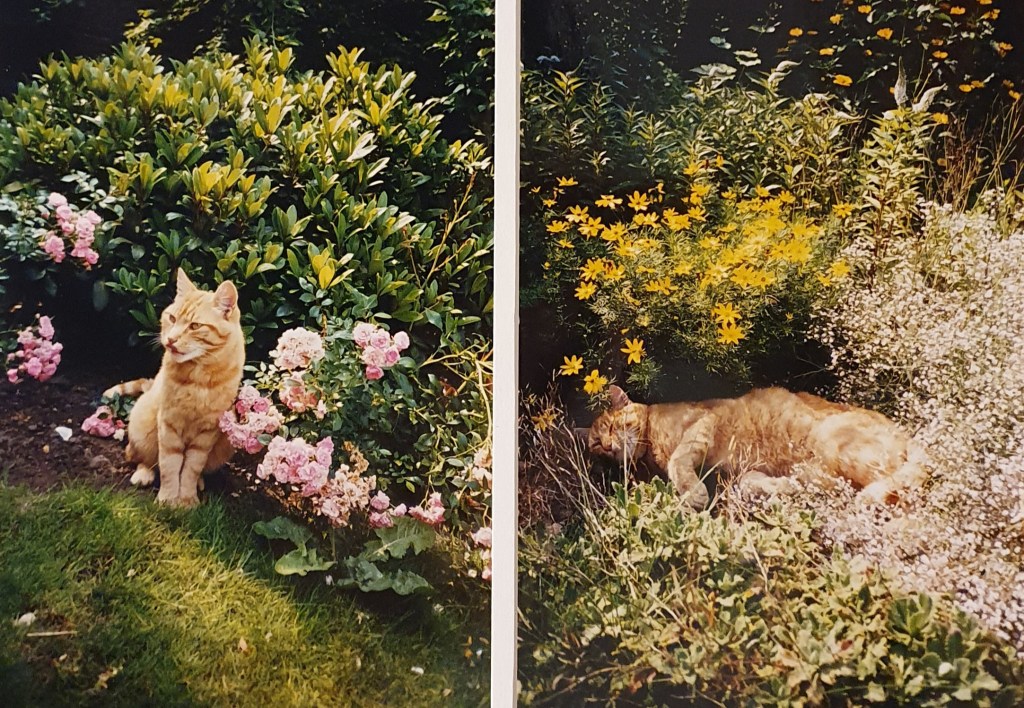
On this special day I wanted to share a picture of one of my first great cat loves. (Don’t tell Dirk it’s not him!)
As anyone who has ever lost a cat knows they are in our hearts forever and so is this ginger boy. Thinking about him, and all my other cat loves, puts a smile on my face!
Many owners will have heard and seen their cat chattering when they spot prey. Indoor cats do it too even if they have never hunted. So why do they do this? Is it because they can’t get to the prey?
In fact, this is normal hunting behaviour. Your cat’s instincts are kicking in – even if they have never hunted they still have those instincts. Experts used to believe cats were excited or frustrated when they chatter or that they were mimicking their prey’s sounds. Cats hunt for a large variety of prey, though, and most of them sound nothing like a cat’s chattering. Most experts now think that the chattering jaw movements are similar to the killing bite. Your cat is eagerly anticipating having a good bite.
Perhaps we can satisfy indoor cats by giving them a toy to chase & catch after the prey has left and give the cat a treat 😉
I think the noise is very funny. I laugh whenever I hear Dirk do it and it’s usually when he sees birds nearby (pigeons seem to love teasing him by sitting on the balcony railing).
I started teaching Dirk to give paw a few months ago and we have now progressed to one knock = right paw and two knocks = left paw. Of course he makes mistakes occasionally, but overall he is pretty good at giving me the paw I’m asking for.
When I first started training Dirk I noticed he has a slight preference to use his left paw. He would always use that oe first and also uses it most frequently. He also uses his left paw most when playing with his puzzle feeders (though he does switch to right paw as well).
Intrigued by his paw preference I started looking into research about domestic cats and left- or right-pawedness and found a very interesting research paper on this topic. Obviously, food was involved in testing the cats as participation needs to be rewarding for them too 😉 However, even that could not convince all cats to participate as 3 out of 41 cats tested did not move a paw at all. Of the other 38 cats, 10 were right-pawed, 12 left-pawed and 16 were ambilateral: they showed no preference for either left or right paw.
The study showed that cats with a clear paw preference, either left or right, were better at solving the food puzzles than those cats that did not have a paw preference. The cats with a paw preference found their way to the food a lot quicker with fewer paw movements.
The researchers discovered that domecats actually preferred opening the food puzzles with their head rather than paw. Those that had a head preference opened fewer sections of the puzzle feeder than those with a paw preference. This means that cats that perfer to use their paws possibly have better motor skills and problem-solving skills than those that prefer using their heads. One possible explanation that some cats have a head preference may be related to domestication: we tend to feed our cats from bowls which does not require any motor skills from the cat.
Does it matter whether a cat is left-pawed or right-pawed, ambilateral or prefers to use their head? In a domestic cat probably not, but perhaps this research gets us one step closer to proving just how intelligent cats are 😉
Many owners buy things for their cat and then their cat doesn’t use them! Cat beds are one such example. How do you know if your cat will decide to use it? Cats often prefer to sleep in elevated places, so position of the cat bed can make a difference. Not all cats sleep in their bed when it is on the floor, but you will increase the chances of your cat using it if you place it on top of a dresser, for example. They also enjoy igloo style beds as this increases their sense of security.
Another thing many cats absolutely love is sheepskin! A small sheepskin rug is a very nice, warm and comfortable bed. And it is flexible too, in the sense that you can put it where you like. You can leave it on the floor or sofa during the day and next to your bed, on your bed or the dresser at night. This means you won’t need many cat beds, just the one rug that you leave in one place or move around the home depending on where you want your cats to spend the night.
Besides being a cat behaviourist I work as a cat sitter as well.
People ask me whether I just feed and clean litter trays all day. Well, yes and no. I mean I do feed cats and clean litter trays, but there’s much more to it. In this series of posts I share some anecdotes from my life as a cat sitter. I promise these stories are all true, though the cat’s names have sometimes been changed to protect their identity 😉
Today, I’d like to share some stories about other animals visiting (or living in) the house of a client. And I’m not talking about the dead, half dead, or remains of mice the cats have brought home…
Although I actually did once encounter a mouse inside the home that was very much alive. The cat was initially very curious about a certain corner in the room, but then sat down next to me. Imagine my surprise when a mouse appeared and started walking along the wall towards the door! I decided to leave the cat to open the door so the mouse could escape. On my way back to the sofa I had to walk past the mouse, by then it had made decent progress towards the door. The terrified mouse squealed and my heart sank. I was certain the cat would come running. Actually, she stayed on the sofa and the mouse made it out the door 🙂
Bye bye mousey
Cats with outdoor access are sure to bring home a surprise every now and then, but not usually while I am there. However, once Isla came walking through the cat flap carrying a bird she’d just caught! She was so proud and made noises to announce she was on her way with prey (you’ll know what I’m talking about if your cat has ever brought home prey). And she was quick too: she’d only left the house a few minutes prior! Now, you should know that Isla is not an only cat… Even if her brother is not a voracious hunter, he was obviously very interested in this possibly very happy meal. As Isla came in she let go of the bird. Well, what ensued were a few minutes of craziness. Cats running, jumping and chattering, the bird flying around trying to get away and I stood in the middle of it all. Things calmed down when the bird sat down on a high shelf. I somehow managed to distract the cats and get them out of the house. I let the bird calm down for a bit and made sure the cats had left before opening the door so it could fly away and find a safer home!
Like butter wouldn’t melt…Yummy!Is it safe again?
Sometimes clients adopt another cat and there is no time for me to meet the new addition before my visits start. That is all right. If I already know the house and the other cat(s) then the new cat often quickly adjusts to having me around. I was once scheduled to visit two cats I’d known for some time. The owner told me she’d recently adopted a third one, a male cat. He’d spend most of his time outdoors, but would come in for meals and to sit on the sofa. She said she’d leave a picture of him on the table so I knew what he looked like. Great! As soon as I walked in I saw the new cat on the sofa. He lifted his head and then went back to snoozing. I was surprised that this cat was a boy, because it looked more like a girl, but then, I hadn’t seen the backside 😉 I started reading the note the client left behind and turned the page to look at the picture. Needless to say that this new cat looked nothing like the picture! Yes, it was an uninvited guest making themselves at home. As it turns out she (yes indeed) was a neighbour’s cat but she often frequented other people’s house looking for food…
Is she gone yet?Can I come in again?
To prevent unwanted cats coming into your home, get a microchip operated catflap 😉







 happycats.london