The 8th of August marks International Cat Day! A day to celebrate all of our kitties 🙂
International Cat Day was originally created in 2002 by the International Fund for Animal Welfare as a way to celebrate the relationship that cats have with people and to support the wellbeing and welfare of cats. It is also a day when people can go to their local animal shelter and rescue a cat.
I’m sure you’ll give your cat some extra love on International Cat Day, but why not celebrate by supporting a cat charity? Check you local Cats Protection website to see if you can help by becoming a fosterer or volunteer. Or support a cat charity through a donation. Not sure which one to support? International Cat Care, Cats Protection and Battersea are a few of the bigger cat charities, but you can also support a more local charity, such as Catcuddles Cat Sanctuary in London.
Well, in all likelihood because you are now working from home and your cat wants your attention!
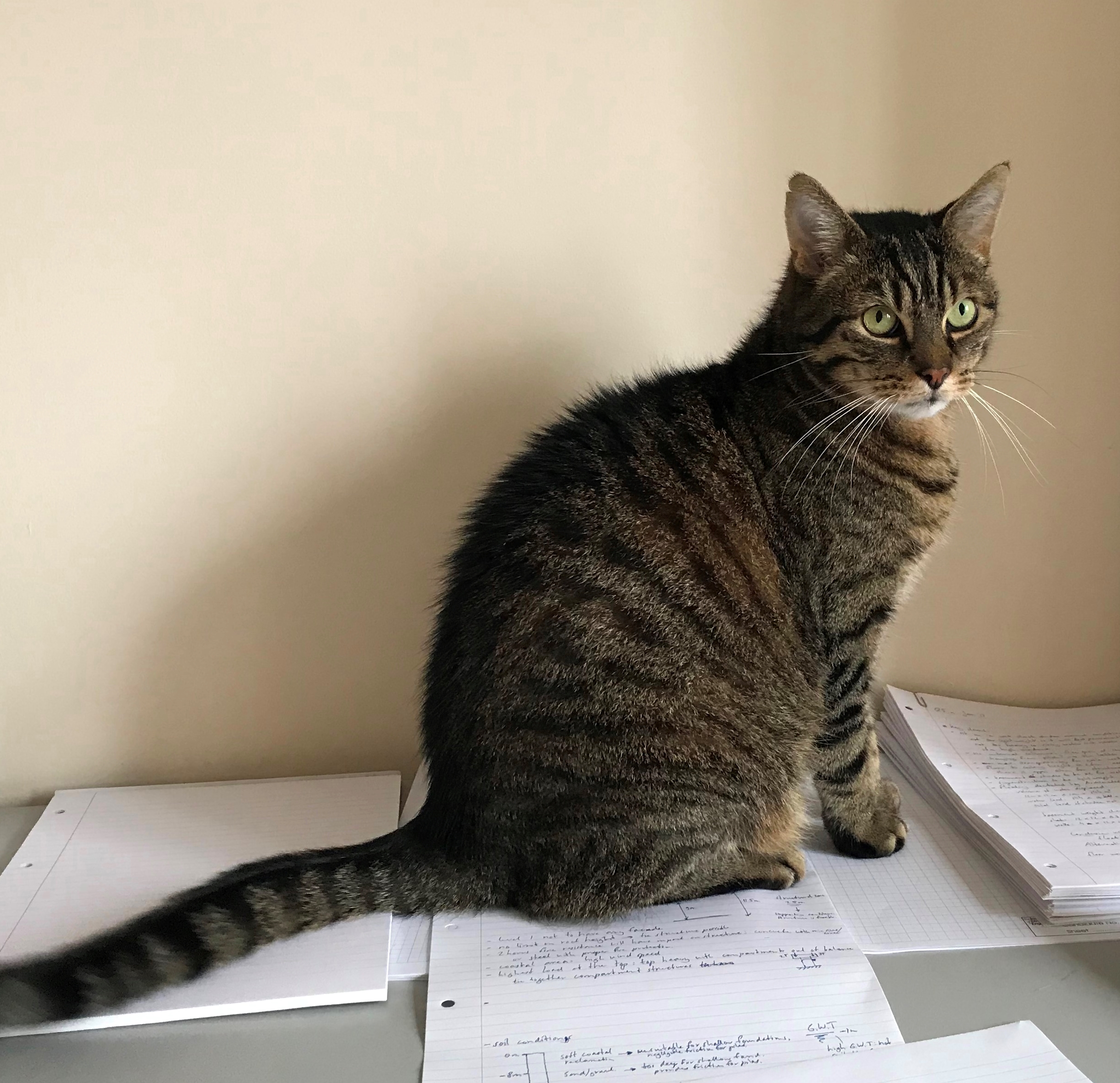
Many of us are now working from home and this can be challenging for both ourselves and our cats. Dirk mostly sticks to his usual routine and seems perplexed to find both me and my husband working from home when he walks into the room. He will demand attention at some point though, usually around 4.30 pm 🙂
However, at times he also looks a little annoyed, as if he’s not getting enough ‘me time’…
How your cat responds to you being at home depends on their personality and their relationship with you – some will look slightly perplexed, if anything at all, and get on with exactly what they do when you’re not there. In which case, you can breathe a sigh of relief and know this information is not for you. Others however, particularly those that are really affectionate and demanding when you are normally at home, will see this as a great opportunity to use you in all kinds of entertaining ways. If this describes your cat… then click here to continue reading Vicky’s advice.
The most important thing is to try to maintain as many routines as possible: feeding time, playtime and normal mornings and evenings. It’s therefore only the bit in the middle, when you don’t leave the house at the usual time, that will feel different. Make sure you find a place to work where your cat doesn’t spend too much time. If you are very lucky and have been suitably quiet, your cat will not have noticed that you are still at home and leave you in peace. This may only be successful until you are desperate for a cup of tea or have to take part in a conference call, at which point your cover is blown. Once your cat establishes where you are, the games begin so read this sequence of events with care, it may happen to you.
1. The obvious first strategy will be for your cat to jump onto your lap, look lovingly at you and miaow faintly to demonstrate his level of hunger and desire for food. Be strong, remember that cats are described as ‘opportunistic feeders’ and this is an ideal time to be ‘opportunistic’ and get something tasty. Your cat is actually not starving and resisting at this stage is not an act of rejection, neither will it look like you don’t love him so just ignore this as best you can. Well done, you have passed the first hurdle and your cat will now be leaving the room with an audible ‘huff’.
2. Sadly, this peace won’t last for long, after having left the room for about 30 seconds, your cat is back and has jumped on whatever surface you are using as a desk. There is a lot of frenzied purring interspersed with more miaowing, noticeably louder than the previous ones when your cat was apparently too weak from hunger to ‘talk’ properly. Your cat now starts rubbing his face backwards and forwards on your hands as you try desperately to type on your keyboard. Every part of you wants to stop typing and give your cat some loving. THIS WOULD BE A MISTAKE! Instead, if you want to get any work done at all while you are home, you need to show your cat that this is not the time or the place. You are now typing nonsense but keep going as you can always delete it all when your cat eventually gives up.
3. Your cat regroups briefly but the third attempt to get your attention has to have impact so he will be trying harder. You may at this stage get a full body flop onto your keyboard (your hands may still be on the keys at this point and therefore temporarily trapped), a flicking tail and a bottom backing menacingly towards your nose or a set of claws dragged slowly and ever so slightly uncomfortably down the side of your face. Stand firm! Focus on the screen, say nothing, pretend you are in the office and your cat is sleeping soundly at home. This is just a dream.
4. If you are very lucky (and truly want this to work) your cat will sit down beside you and start to stare really hard in your direction. You are nearly there, you can do this. Do not under any circumstances look at your cat, even if you can feel his eyes burning into your right cheek.
5. Time is passing, it feels like hours but in reality, it’s probably only been a minute but as far as you can tell no further strategies are forthcoming from your cat. This is going well, you have managed to delete your cat’s contribution to your work and you are back on track. You are beginning to ignore your cat’s stare, you are in the zone and working just like you were in the office. Your cat is behaving impeccably, no messing about, no attention-seeking and you are thinking ‘what’s so hard about this? You just need to show them who’s boss!’. You notice out of the corner of your eye that your cat has stood up and, after a stretch and a yawn, he very calmly and deliberately walks across in front of you treading on the ‘off’ key as he goes. Never under-estimate the ability of the cat to have the last word.
Calling all artists: get creative and design a feline-inspired artwork to feature on an iCatCare t-shirt
We are excited to be launching an Artwork Competition to raise money for International Cat Care and we need your help! If you have an artistic streak and would like to create a design to feature on a t-shirt to be sold in the iCatCare shop, then this is the competition for you. As some of you might know, we hold an annual photo competition – this competition is to give people who enjoy creating artwork the opportunity to get involved too.
What are the rules?
Create a unique feline-inspired piece of art which would look good on a t-shirt. This could be a drawing, cartoon, rhyme or any other original work – be as creative as you like!
The competition runs until 10.00 am(GMT) on Monday 17th February 2020. There is no limit on the number of entries a person can make, so if you have more than one design please enter them, as long as it’s before the competition closes.
All entrants must agree to the terms and conditions, click here to view.
How to submit?
The size of the artwork can’t exceed 210 × 297 millimetres (A4) and must be submitted using Woobox or by post. Entries should be submitted in high-resolution format, either editable EPS or PDF file.
What will you win?
The winning artwork will be selected by the iCatCare judges and then be printed onto a t-shirt (and potentially other materials) which will be sold to raise funds for the charity’s work. The winner will receive their design on a t-shirt AND £50 in prize money.
Cats have a reputation for being hard to read, but new research from the University of Guelph has found that some people are “cat whisperers” who excel at deciphering subtle differences in cats’ faces that reveal mood.
Women and those with veterinary experience were particularly good at recognizing cats’ expressions — even those who reported they didn’t feel a strong attachment to cats.
“The ability to read animals’ facial expressions is critical to welfare assessment. Our finding that some people are outstanding at reading these subtle clues suggests it’s a skill more people can be trained to do,” said Prof. Lee Niel, who led the study with Prof. Georgia Mason, both from the University of Guelph’s Campbell Centre for the Study of Animal Welfare.
The only research so far on readings cats’ faces has focused on expressions of pain. “This study is the first to look at the assessment of a wider range of negative emotional states in animals, including fear and frustration, as well as positive emotional states,” said Mason.
The videos showed cats experiencing either positive emotional states (situations the cats had sought out, such as being petted or given treats), or in negative states (such as experiencing health problems or being in situations that made them retreat or flee). Each video was focused on the cat’s face –its eyes, muzzle and mouth. None of the cats showed expressions of fear, such as bared fangs or flattened ears, since these facial expressions are already widely understood.
To test your own cat-reading abilities, the research team has created a website with details.
As a cat sitter I regularly need to give pills to my clients’ cats. Some cats have a reputation for spitting out the pills even when they have seemingly swallowed it. They walk away and when you walk over to see them a few minutes later there’s a pill on the floor. Other cats are very relaxed about it: they just eat a pill when it’s mixed in with their food (dry or wet) or hidden inside a treat.
And then there’s my own cat…. He’s generally placid, as those of you who regularly read about Dirk will know, but try giving him worm treatment…. You can hide it in his wet food (which he only gets as a treat) and he won’t touch it. He won’t even eat it if I crush the pill into a very fine powder and then mix it into his food – which works fine with his fibre supplement. I brush his teeth so he is quite used to me restraining him, opening his jaw and putting a toothbrush in his mouth so that can’t really be it either.
In fairness to Dirk – or perhaps just to make myself feel better – I blame the size of the pills. He needs XL sized worm tablets as he is over 4kg. Or perhaps it is the smell and/or taste because breaking the pills into two doesn’t help much either. Maybe this is his one act of defiance, his one thing to show me he’s still a wild cat at heart 🙂
Because Dirk is such a tricky customer when it comes to worm treatment I have tried a lot of things! Everything works once; second time I try it Dirk is having none of it. However, these might work for you so here’s what I’ve tried so far.
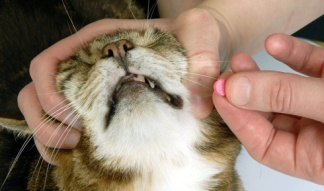
My husband restrained Dirk and I tilted his head back just as is shown in the video on International Cat Care’s website. I put the pill inside and then released my grip on his head but kept his mouth closed. What happened next? Foaming at the mouth, angry growling noises, he was doing everything he could to escape. I was afraid that I’d hurt him because I saw blood in his mouth only to discover that is was MY blood because he’d bitten my fingers! It started with all of us being calm and I was gently reassuring Dirk that everything was going to be all right but it ended with everyone being upset and the pill on the floor.
The pill popper was a promising idea. My fingers wouldn’t need to go inside Dirk’s mouth and you can put the popper in the back of the throat so the cat is more likely to swallow it whole. The vet showed me how to do it and it worked. However, the warning signs were there as Dirk had the most angry look on his face afterwards. Needless to say it didn’t work when we tried it at home a few months later.
Next we tried the pill pocket. I’ve been using this quite a lot with clients’ cats so I was optimistic. I broke the pill into two halves and put each half inside a pocket. I first gave Dirk an empty pocket so he could taste it and see it as a treat. He loved it! I was a bit worried he’d smell the pill inside, but he ate the first pocket with half a pill inside without problems. Great! Except he then refused to eat the second half.
Back to the vet for more ideas.
The vet nurse recommended a sort of paste. She said it had made her life so much easier as she sometimes was the only one on shift and needed to administer pills by herself. Just warm the paste in your hand and them wrap it around the pill and the cat will happily eat it. Well true enough, Dirk happily ate it…. Just the once. Now he won’t even eat the paste itself.
As Dirk is an indoor only cat we’ve resorted to the vet giving him his worm treatment during his check-ups. Dirk goes every 6 months because he’s getting a bit older so now he gets worm treatment twice a year. Not ideal, but we keep his flea treatment up to date so the vet is OK with this worm treatment regime.




 d I tilted his head back just as is shown
 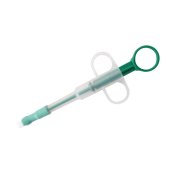 The pill popper was a promising idea. My fingers wouldn’t need to go inside Dirk’s mouth and you can put the popper in the back of the throat so the cat is more likely to swallow it whole. The vet showed me how to do it and it worked. However, the warning signs were there as Dirk had the most angry look on his face afterwards. Needless to say it didn’t work when we tried it at home a few months later.

 happycats.london