Challenges of keeping indoor cats happy

* Originally written by me for citikiti.co.uk

From the ICatCare Conference

Vicky Halls, the well-known cat behaviour counsellor, was one of the expert speakers at the conference in Birmingham. One of her presentations focussed on keeping cats happy, especially indoors cats. My own cat lives indoors and so do many of our clients’ cats. There are many things we can do to keep our cats happy: activity feeders to prevent boredom and combat overeating, playing games with our cats and providing hiding & resting places for our cats.

The biggest challenge, however, is our relationship with cats and this was the topic of Vicky Halls’s talk.

I will be the first to admit that I talk to my cat and I also talk to your cats when I’m visiting. I say hello to let them know I’m there, they hear my voice and pick up on my energy and decide whether or not they want to coma and say hello to me. I am under no illusion, though: my cat has no idea what I’m talking about. He is, after all, a cat!

Sure, our cats know certain words. ‘Treats’ is one such example. My cat usually comes over when I use his name, but we all know that cats sometimes hear their name being called but choose to ignore it! So cats recognise some words and may respond to them, but this doesn’t mean they always understand what we are saying.

Picture the following ‘ conversation’ with your cat: “Hi sweet pea, I’m home!!! Where are you? Come on out. I’m so sorry I’m late, are you hungry? Did you miss me? Yes, you missed me, I missed you too! I’m sorry I was away all day, you must have been so lonely!”
We may not use those specific words or voice those feelings, but many of us feel guilty for leaving the cat alone all day and feel the need to give the cat quality time when we get home. We tend to think of our cats as family members. While it is great that we care so much about our cats, we should always keep in mind that a cat’s needs are not the same as our own. Or, as Vicky Halls put it, we shouldn’t make the mistake of thinking: me + love = happy cat.

When you read the ‘conversation’ I wrote above you can well imagine that the amount of love and focus and energy is all a bit too much for your cat. Cats are happiest when they have a sense of control over their environment and their interaction with us. Some cats enjoy a lot of fuss and cuddles, but most cats are quite happy just sitting in the same room with us or on the sofa next to us and just being stroked occasionally. They enjoy playing games with us, mainly games that mimic their natural behaviour such as hunting.

When your cat can go outside, they can ‘escape’ us for as long as they want to and they are quite happy on their own! Indoors cats don’t have the luxury of escape, so we should respect their need to control their environment and the quantity and quality of interaction they want. And who knows, your cat may well give you a slow blink to thank you!


Dirk’s trip to the vet in the Rotho Foldable Pet Carrier

* Originally written by me for katzenworld.co.uk

We all know that time of year: time for your cat’s annual health check & vaccinations.

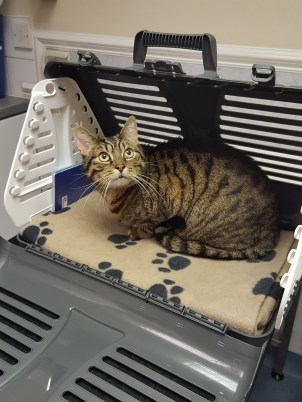
Rotho 1 Is this my new bed?
Dirk’s cat carrier is always standing below my desk with one of his blankets in there so he can go in there for a nap if he likes. He actually goes inside to take a nap sometimes so he doesn’t “hate” the cat carrier itself. However…. when it’s time to take him to the vet it’s a different story. No doubt he picks up on small changes in my body language or perhaps I’m not quite as calm as I’m trying to be. In any case, he always tries to get away from the cat carrier when I want to get him inside. I manage to get him calmed down and walk inside on his own, but it’s not the best start to any vet visit.
For a while now I’ve been looking for a cat carrier that is easy to carry – I use public transport to get to the vet – and is also easily accessible. I’ve tried the Rotho Foldable Pet Carrier and it truly is the best cat carrier I’ve ever had!
I made sure Dirk’s blanket was inside the new carrier and left it in the living room or bedroom for a few days before taking him to the vet.
I would also recommend practising folding the carrier open & then back together again a few times before using the carrier. Once you get the knack of it it’s really quite simple, but I’m not that dexterous 🙂
Both rectangular panels of this carrier can be opened. This makes it very easy for your cat to walk in there. I put a treat on Dirk’s blanket and he just walked in – no stress at all!
The carrier is very lightweight and easy to carry. You can even attach a strap (not included) to carry it over your shoulder or pull it along as the carrier has wheels too. I imagine that might work quite well with small dogs as they are used to being walked on pavements too. I don’t think many cats would like being pulled along on the pavement, but would be curious to hear if anyone tries this 🙂
The carrier fits perfectly inside the luggage racks on the bus so your cat is safe during your trip to the vet 🙂 Once at the vet I put the carrier on one of the cat friendly shelves so he felt safe and could take a peek at what was going on!
Let’s see what’s going on here….
When we were in the consultation room I opened both sides of the foldable cat carrier. I am not a cat – LOL – but I can imagine it feels a lot less threatening to be approached by the vet in this carrier as opposed to many others (where they can either claw at hands that are trying to grab them or use their legs to resist being lifted in&out)
Rotho 6 I’m ready to go now!!
The vet was also really impressed with how it folds open. Dirk doesn’t mind being at the vet’s and he loves the vets and vet nurses, but I can really see how this carrier would benefit vets and cats who get quite scared at the vet’s.
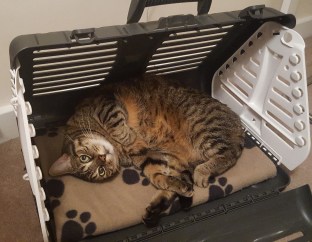
Rotho 7 I still think it’s a new bed 🙂

To purchase one of these check out the Katzenworld Shop

How to help our arthritic cats

ICC-2404

* Originally written by me for citikiti.co.uk

From the ICatCare Conference

Like people and dogs, aging cats can suffer from arthritis. In itself this doesn’t sound too surprising, but this disease has been under-diagnosed. In part, this is because cats rarely show signs of illness unless and until they are seriously ill; in part this is because symptoms of arthritis can easily be dismissed as signs of ‘old age’. Astonishingly, research has shown that around 90% of cats older than 12 years suffer from joint disease.

Arthritis is very painful, but many cats will try to hide the fact they are suffering. However, there are signs your cat may be suffering from arthritis. One of the things you may notice is that your cat no longer jumps up or down or is quite hesitant to do so. You may notice their legs are stiff, especially after the cat has been resting for a while.

They may sleep more and play less. Your cat may be a bit grumpy when you pick him up or stroke him. And because their joints are painful it may be difficult for them to use the litter tray: you may notice ‘bum sticking out’ types of litter tray accidents or an accident near the tray because the cat couldn’t manage to posture correctly inside the tray.

International Cat Care has created a checklist that you can use if you suspect your cat may be suffering from joint disease: https://icatcare.org/…/kcfin…/images/mobility_check-list.pdf

Obviously, a vet needs to make the diagnosis and will discuss treatment with you.

Besides medical treatment there are many things we can do at home to make our aging cats’ lives a bit easier.
• Make sure the cat’s sleeping & hiding places are easily accessible: either build steps or a ramp so your cat doesn’t have to jump to get to his favourite resting places. And give your cat soft and warm beds.
• Provide a large litter tray that is easy to step in to and out of: either make sure the litter tray has a lowered side so your cat doesn’t have to lift its legs too much or build a ramp for easy access. Use sandy litter, that is nice and soft underneath their feet.
• Food and water should be within easy reach: provide raised bowls so they don’t have to stretch their neck too much to reach it.
• Food, water and litter trays should preferably be available on every level of the house so your cat doesn’t have to go up- or downstairs to use these essential resources. Walking up and down the stairs can be quite painful for the arthritic cat.
• If your cat uses a cat flap: provide steps or a ramp on either side of the cat flap for easy access.
• Maintain a healthy weight: extra weight just put more pressure on those painful joints.

And let’s not forget some TLC: groom and play with your cat. Your cat will have more difficulty grooming himself, but most cats enjoy feeling prim and proper. They will be quite grateful to receive some gentile grooming with a soft brush.

Play with your cats too. Cats are naturally playful and frequent short play sessions will help ease the pain in their joints. Hunting style games are interactive and mimic the cat’s natural behaviour, so he will surely appreciate this. And of course it’s fun for you too

For more information about arthritis in cats see International Cat Care’s website.

Dirk aiming to beat the Flab

I don’t know about your cats, but my lovely Dirk is a bit overweight… According to International Cat Care about 39-52% of cats in the UK are overweight or obese, so Dirk is certainly not the only one. As you all know, being overweight can lead to other health problems as well, diabetes for example.

It can also lead to issues with the lower urinary tract, such as cystitis. I didn’t actually know this until Dirk developed urinary issues (bladder stones) 6 years ago. At that point he weighed 5.9 kg, so his weight may well have been a contributing factor. He’s a pretty big guy, but should really weigh around 5 kg.

So, how to beat the flab?

Given his bladder and weight issues, Dirk is permanently on a special diet, which also means he doesn’t get treats… Fortunately he seems to love his dental dry food as much as treats, so we make him chase those all around the house. We strictly monitor how much he’s eating and of course we try and get him to play as much as possible. Luckily he loves his toys 🙂

He can’t go outside, which would have been an ideal way for him to lose weight, but we let him run up and down the stairs in our apartment building. He absolutely loves it!

His weight has been coming down slowly but steadily, and he’s been at 5.3 kg for a while now (yes, he has a waistline again!).

How has he managed to lose weight?

A few years ago we also started using activity feeders. He used to have a feeder ball during the day and a bowl of food during the night.

Beat the flab 2

Admittedly, Dirk was not immediately taken by the feeder ball. Initially he just ignored it (or didn’t get it) and would wait till evening when we put his food in the bowl… Eventually his curiosity got the better of him and he started playing with the ball. He then discovered food coming out of it! Now he’ll happily chase the ball all around the apartment.

Two issues with the ball, though. First, when you’re trying to sleep and you keep hearing the ball being knocked against the door or walls, that’s not great. And second, whenever we’re on holiday and one of my cat sitting colleagues takes care of him, Dirk always hides the ball (preferably under our bed, shoe cupboard or the sofa). Yes, he prefers a ready meal 🙂

beat-the-flab-1
Where’s my food?

We tackled this issue by getting him two more activity feeders, but ones that he doesn’t actually have to move around the house: the toilet roll tower and activity board.

beat-the-flab-3-4

He now always has access to his food, but always has to work for it. He’s eating smaller portions more often during the day and actually seems to enjoy the food games. Hopefully it will also help him lose those final 300 grams to reach his target weight!

beat-the-flab-5
And it even works for wet food – don’t worry, your cat will clean up the mess :-)

ICat Care Conference 2017

Originally written by me for citikiti.co.uk

Last weekend I proudly represented CitiKiti at the annual ICatCare Conference Weekend in Birmingham.
As a cat owner and cat care professional this was a great opportunity to meet other cat lovers and learn more about cat improving cats’ physical and mental health.

When I arrived I saw quite a few people in cat outfits: shirts, leggings or dressses. Luckily I was carrying a CitiKiti bag, so I was neither too over- or underdressed 😉

Saturday was quite a busy day with a lot of lectures on cat health and wellfare. We covered topics such as kidney disease, arthritis and stress and had discussions about breeding, cat friendly vet clinics and rehoming centres.

In between lectures there was plenty of time to socialise and chat about our own cats. One of the great things about the conference was that there were so many cat lovers and cat professionals. I had a chance to talk to vets, vet nurses, breeders and cat behaviourists.
Sunday was all about behaviour and we were presented with a fictional case – though based on Vicky Halls’s real experience – of a young male cat with behaviour problems. We discussed the young cat’s problems from various perspectives: the breeder’s and owner’s roles and also what a cat’s vet and vet nurses, cat behaviourists and rehoming centres can do to tackle behavioural issues.

It was a lot of fun and very informative too. I learned so many things over 2 days! It’s always good to learn more about our cat friends because as CitiKiti cat sitters we want to take the very best care of your cats when you need us to.

As Vicky Halls reminded us, taking care of cats is about education, education, education. There are always new things to learn about cats and their needs. Over the next few weeks I’ll be sharing some of the things I learned at this year’s conference & hopefully you’ll find it useful too.